



Professional K9 Training in GA: Find the Right Path for Your Dog
Could professional K9 training GA help with challenges in everyday life, not just prepare a dog for demanding work? If leash walks, listening at home, or behavior concerns are causing stress, you’re not alone. Professional training can support practical goals, and it isn’t only for working dogs. The...

Could professional K9 training GA help with challenges in everyday life, not just prepare a dog for demanding work? If leash walks, listening at home, or behavior concerns are causing stress, you’re not alone. Professional training can support practical goals, and it isn’t only for working dogs. The right approach should fit your dog, your household, and what you want to accomplish together.
Choosing a format can feel overwhelming when you’re unsure what your dog needs. This guide explains what professional training involves, how different options fit different goals, and what to expect from the process. An evaluation determines program acceptance and the recommended training plan, so the first step is understanding your dog as an individual.
Alan’s K9 Academy serves dog owners across North Metro Atlanta, including Cartersville and Bartow County. Founder and Master Trainer Alan Carr has over 35 years of professional dog-training experience. His personalized approach brings the trainer, dog, and owner together as a team. Learn how in-home training, behavior modification, group classes, and therapy or service dog training can support real-life goals and help you choose a next step.
Key Takeaways
• Professional K9 training GA can support everyday goals, from better manners to behavior concerns, and isn’t limited to working dogs.
• An evaluation determines program acceptance and a training plan suited to your dog.
• Compare in-home coaching, group classes, and specialized training goals to find a format that fits your needs.
• Identify practical priorities and consider how your dog behaves at home and in real-world settings.
• Alan’s K9 Academy is led by Master Trainer Alan Carr, who has over 35 years of experience. The academy is a Best of Georgia winner for 2024 and 2025.
Professional K9 Training for Georgia Dog Owners
Does “K9 training” sound like it’s only for police, military, or other working dogs? The term can bring specialized roles to mind, but professional training can also help family dogs develop everyday skills. A dog that pulls toward passersby, ignores a recall cue, or struggles to settle at home doesn’t need the same plan as a dog learning specialized tasks. The starting point is the goal, the dog, and the people who live and work with them.
Professional pet-dog training is structured, expert-guided learning that helps a dog and owner build practical skills for home and community life; specialized working-dog training prepares dogs for distinct job-related duties. Both involve instruction and practice, but their purposes and plans differ. Household goals might include responding to familiar cues, greeting visitors with better manners, or addressing a challenging behavior. A professional K9 training GA program should be purposeful and tailored, not automatically intense or based on working-dog demands.
Does professional K9 training only serve working dogs?
No. Professional training can address household and community needs, including obedience, manners, confidence, and behavior concerns. You might want calmer leash walks, a more dependable response when called, or routines that make visitors less stressful for your dog. These goals matter even if your dog has no specialized job. The approach and level of structure should reflect the dog’s needs, not a one-size-fits-all idea of what “K9” training must look like.
Owners often seek help when an everyday issue becomes hard to manage. Barking, jumping, pulling, or difficulty settling can disrupt family routines and outings. Training can provide a clearer way to teach and reinforce useful responses, though progress varies with the dog, the goals, and the consistency of practice. For a broader overview of dog training principles and methods, consider how teaching approaches rely on communication, practice, and reinforcement.
Why owner-dog communication matters
Training is a partnership, not a handoff. Dogs learn more clearly when cues are understandable and household routines are consistent. If one person rewards a behavior while another responds differently, the dog may receive mixed signals. A trainer can help owners give clear cues and reinforce skills between sessions. Those repeated moments at home connect a lesson with daily life.
Progress doesn’t mean expecting instant perfection. It means working toward realistic steps, noticing what helps your dog succeed, and building on those skills over time. A dog may need support with one priority before handling distractions more comfortably. At Alan’s K9 Academy, an evaluation determines program acceptance and the recommended training plan. The academy’s balanced, customized approach combines positive reinforcement, clear communication, structure, and appropriate tools to support the dog and owner’s work together.
How professional K9 training in Georgia is tailored to each dog
A useful training plan begins with your dog, not a preset list of lessons. At Alan’s K9 Academy, an evaluation connects your goals with your dog’s needs. Program acceptance and the recommended training plan are determined through that evaluation, so the next steps are based on the individual dog rather than assumptions about breed, age, or behavior.
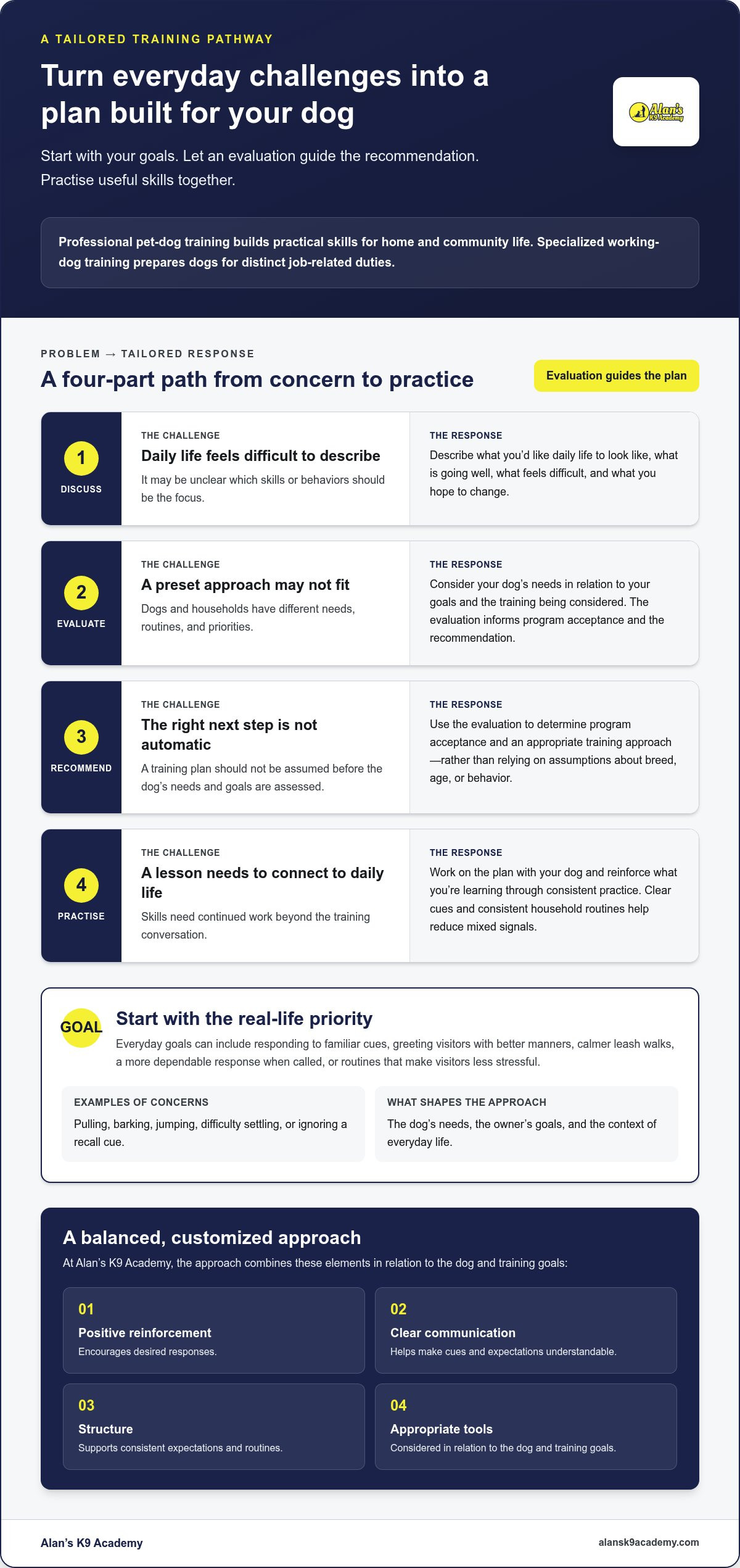
An evaluation connects your goals with your dog’s needs so the recommended training plan can be customized to both. The process follows a clear sequence:
Discuss your goals.
Describe what you’d like daily life to look like and which skills or behaviors you want to address.
Evaluate the dog.
Consider the dog’s needs in relation to those goals and the training being considered.
Recommend a plan.
Use the evaluation to determine program acceptance and an appropriate training approach.
Practise the skills.
Work on the plan with your dog and reinforce what you’re learning through consistent practice.
What happens during an evaluation?
An evaluation provides a starting point for understanding your dog and your priorities. Be ready to explain what’s going well, what feels difficult, and what you hope to change. You might want to improve everyday manners or get support for a behavior concern. The evaluation informs program acceptance and the recommended training plan, so neither should be assumed before your dog’s needs and goals are assessed.
This individual focus matters because dogs can respond differently to the same situation, and owners have different routines and priorities. An evaluation connects those details to an appropriate recommendation instead of promising a predetermined outcome. It also gives you a chance to explain the real-life context behind your goals, keeping training focused on meaningful changes for your household.
What does a balanced, customized approach mean?
At Alan’s K9 Academy, a balanced approach combines positive reinforcement, clear communication, structure, and appropriate tools. These elements are considered in relation to the dog and the training goals. Positive reinforcement encourages desired responses, while clear communication and structure make expectations easier to understand. Customization means matching the approach to the training need instead of treating every dog or behavior concern alike.
Practice is part of the process. The trainer, dog, and owner work as a team, with owners reinforcing skills between sessions and applying them in relevant settings. A recommendation is a starting path, not a promise of instant change. Progress takes practice and may look different from one dog to another.
Georgia includes programs focused on specialized K9 disciplines, such as those described by professional K9 training programs in Georgia. For family dogs, consider how training can address your household’s specific goals. Alan’s K9 Academy offers personalized dog training and behavior support to help you take a practical next step.
Compare professional K9 training formats for North Metro Atlanta goals
The right training format depends on what you want to practise, what your dog needs, and where learning will be most useful. A household working on skills at home may have different priorities from an owner who wants to practise obedience around other dogs or pursue therapy or service dog training. This comparison can help you think through the options. An evaluation determines program acceptance and the recommended plan.
| Format or goal | Useful focus | Owner’s role |
|---|---|---|
| In-home coaching | Skills and routines in the dog’s familiar home setting | Practise and reinforce cues in everyday household situations |
| Group classes | Structured obedience practice with other owners and dogs | Work with your dog around class activity and distractions |
| Specialized training goals | Therapy or service dog training objectives | Take part in a plan shaped around the dog and goal |
When can personalized in-home training be a fit?
In-Home Dog Training can fit goals that involve the household itself. You may want to practise polite greetings at the door or build a routine that helps your dog settle during family activity. Training in a familiar space lets you practise skills where you’ll use them. Explore the professional in-home dog training guide to learn more about personalized coaching.
What can structured group classes help owners practise?
Group Classes provide trainer-led, structured obedience practice alongside other owners and dogs. You can work on cues while your dog notices nearby activity, rather than practising only in a quiet room. Class provides an opportunity to practise, not a promise that a dog will respond perfectly in every situation. Owners reinforce skills beyond class and build confidence at a pace that suits their dog.
When might behavior-focused support be relevant?
Behavior Modification may be relevant if anxiety, reactivity, destructive behavior, or impulse-control concerns are disrupting daily routines. These challenges differ from dog to dog, so the right fit isn’t determined by a label alone. Individualized recommendations depend on an evaluation of the dog and the owner’s goals. For more detail on behavior-specific topics, see the dog behavioral training guide.
Think about where you most want change: at home, around other dogs, or in pursuit of a specific training goal. Then consider how much practice you can build into your routine. No single format is right for every dog or household. The goal is to match the training setting to your priorities and your dog’s needs, then work together on practical skills over time.
Choose professional K9 training around your dog’s needs and Georgia routine
A training goal is easier to discuss when it’s tied to a real moment in your day. Instead of trying to solve everything at once, choose one or two priorities. You might want your dog to come when called, greet people with better manners, or get support for a behavior concern. A focused starting point clarifies what matters most and gives training a practical purpose.
Which training goals should you bring to an evaluation?
Describe the situation as you experience it: where it happens, what your dog does, and what you’d like to happen instead. For example, explain whether pulling occurs on every walk or mainly near other dogs. If your dog struggles to settle, note whether it happens during meals, when visitors arrive, or at another routine time. These details give the trainer useful context for understanding your priorities and making recommendations. An evaluation determines program acceptance and the recommended plan.
It can help to jot down a few observations beforehand:
• The specific behavior or skill you want to address.
• The places and situations where it tends to happen.
• What you’ve already noticed about your dog’s responses.
• How you’d like everyday life to look as training progresses.
Keep the goal concrete. “Better manners” might mean waiting calmly while you open the door. “Reliable recall” might mean responding to your cue in a familiar outdoor setting. Clear examples turn broad concerns into skills that can be practised and reinforced.
How does local, real-world practice support training?
Dogs need opportunities to use skills in the places where owners rely on them. Home routines, backyards, neighborhood walks, parks, downtown areas, and pet-friendly stores can all bring different sights, sounds, and activity. The useful practice setting depends on the goal. A calm response at home may be one priority; paying attention to you during a neighborhood walk may be another. Training can account for everyday environments without assuming every dog is ready for every distraction at once.
For owners focused on cues and manners in daily situations, the North Atlanta dog obedience training guide offers additional context on real-world reliability. Alan’s K9 Academy serves Cartersville, Bartow County, and North Metro Atlanta, including communities such as Kennesaw, Marietta, Roswell, and Woodstock. This local focus connects training priorities to the routines owners want to navigate with their dogs.
Start with the setting that matters most to your household and the skill that would make a meaningful difference there. Explore dog training support for your goals and bring that priority to your evaluation.
Start professional K9 training with Alan’s K9 Academy in North Metro Atlanta
Finding the right training partner means more than choosing a class or a set of commands. You want guidance that takes your dog’s needs seriously and helps you build skills for daily life. Alan’s K9 Academy serves Cartersville, Bartow County, and the North Metro Atlanta area with personalized training that brings the trainer, dog, and owner together as a team.
Founder and Master Trainer Alan Carr has over 35 years of professional dog-training experience. Alan’s K9 Academy is a Best of Georgia winner for 2024 and 2025. Veterinarians throughout North Metro Atlanta refer clients after seeing the quality of our work and results. The academy’s approach emphasizes understanding each dog and helping owners take an active part in training.
What can local owners expect from Alan’s K9 Academy?
Training is shaped around your dog’s needs and the goals you bring forward. Depending on the evaluation and recommended plan, support may address obedience, behavior concerns, or therapy and service dog training goals. The approach combines positive reinforcement, clear communication, structure, and appropriate tools. Owners practise skills with their dogs and apply them in real-world settings, connecting learning to situations they encounter at home and in the community.
The Life-of-Dog Support Guarantee applies to commands and issues included in the program, subject to terms. It defines the scope of continued support; it doesn’t promise that every behavior concern will disappear or that progress will happen instantly. Training takes practice, and your participation helps reinforce what your dog is learning.
What is the next step toward a training plan?
Start with an evaluation. It determines program acceptance and the recommended training plan, since the right recommendation depends on your individual dog and goals. Bring a clear picture of what you’d like to work on, such as an obedience skill, a household routine, or a behavior concern. Sharing where the challenge occurs and what you hope will change makes the discussion specific and useful.
Pricing depends on your dog’s needs, and an evaluation is required for an accurate recommendation. Start by discussing your training goal rather than choosing a plan based on assumptions. The evaluation helps establish a suitable path and determines whether your dog is accepted into a program.
If you’re considering professional K9 training GA, schedule an evaluation with Alan’s K9 Academy. Bring your questions, priorities, and perspective on life with your dog. Together, you can work toward a practical training plan that fits your goals and supports a stronger partnership.
Take the Next Step Toward a More Confident Partnership
Your next step doesn’t have to solve every challenge at once. Choose one meaningful change you’d like to work toward and consider what progress would look like in your everyday routine. That gives you a clear place to begin and helps keep expectations grounded as you and your dog practise together.
The right professional K9 training GA path fits your dog’s needs and your life, with room to adjust as you learn what supports your partnership. An evaluation can turn your priorities into a recommended training plan and determine program acceptance. Bring your questions and observations; they’re useful starting points for a thoughtful conversation about your dog.
Schedule an evaluation with Alan’s K9 Academy and take a positive next step for you and your dog. With patience, clear goals, and the right guidance, meaningful progress can begin one skill at a time.
Frequently Asked Questions
What does professional K9 training include for a family dog?
For a family dog, professional K9 training can include obedience foundations, puppy skills, Behavior Modification, or Group Classes. Goals might include sit and stay, recall, polite greetings, or building confidence in everyday situations. The focus is on skills that support life with your dog, not only working-dog duties. At Alan’s K9 Academy, training is personalized, and an evaluation determines program acceptance and the recommended plan.
How much does professional K9 training in Georgia cost?
Pricing depends on the dog’s needs, so there isn’t one price for every program. An evaluation is required for an accurate recommendation and determines program acceptance and the recommended training plan. Sharing your priorities, such as puppy foundations, recall, or behavior support, gives the trainer useful context for discussing a suitable path.
Can older dogs or dogs with challenging behavior be evaluated for training?
Dogs of different ages and temperaments can be evaluated, including dogs with concerns such as anxiety, reactivity, aggression, or destructive behavior. The evaluation determines program acceptance and the recommended training plan. Describe when the behavior occurs and how it affects your routine to help guide a realistic discussion about your dog’s needs and possible next steps.
How does a dog training evaluation determine the recommended plan?
An evaluation connects your training goals with your dog’s individual needs. Be prepared to describe what you’d like to improve, where challenges arise, and what you’ve observed so far. This information helps determine program acceptance and the recommended training plan. A dog needing help with recall may have different priorities from one struggling with anxiety at home, so the plan is based on the evaluation rather than a preset approach.
Where does Alan’s K9 Academy conduct training in North Metro Atlanta?
Training can take place in a client’s home and in real-world environments, including backyards, neighborhoods, parks, downtown areas, and pet-friendly stores. Alan’s K9 Academy serves Cartersville, Canton, Woodstock, Marietta, Rome, Acworth, Kennesaw, Sandy Springs, Roswell, Alpharetta, Powder Springs, Dallas, Hiram, Jasper, Cumming, Holly Springs, Ball Ground, and Milton. The setting depends on the training goals and recommended plan.
What training methods does Alan’s K9 Academy use?
Alan’s K9 Academy uses a balanced, customized approach combining positive reinforcement, clear communication, structure, and appropriate tools. This means making cues understandable, reinforcing desired responses, and establishing routines that help a dog learn. The approach is tailored to the dog and training goals rather than treating all behavior concerns alike. Owners take part and practise skills between sessions to support learning in daily life.
Are payment plans available for dog training?
Financing options are available through Affirm, Klarna, and LendingUSA, subject to approval and the terms established by each financing provider. Pricing depends on the dog’s needs, and an evaluation is required for an accurate recommendation. The evaluation helps establish the recommended plan and gives you an opportunity to discuss your goals alongside payment options.