



My dog failed puppy class: how to practice at home
A setback in puppy class doesn’t mean your dog can’t learn. If your dog failed puppy class, start by making practice calmer and clearer at home: use the same cue each time, pause to let your puppy respond, and keep sessions short.It’s understandable to feel discouraged when your puppy struggles arou...

A setback in puppy class doesn’t mean your dog can’t learn. If your dog failed puppy class, start by making practice calmer and clearer at home: use the same cue each time, pause to let your puppy respond, and keep sessions short.
It’s understandable to feel discouraged when your puppy struggles around other dogs, people, or distractions. A group setting can make it hard to focus, and skills learned at home often need practice before they carry over elsewhere. That’s a challenge with the starting point, not a verdict on your puppy.
You’ll learn how to build consistency across your household, respond patiently when your puppy needs more time, and practice everyday skills in manageable steps. We’ll also cover common challenges and explain when personalized in-home support may help you and your puppy move forward with confidence.
Key Takeaways
• Choose one verbal cue for each behavior, and make sure everyone at home follows the same rules.
• Give your puppy a chance to process a cue before repeating it; calm, patient timing can make practice clearer.
• Build skills into everyday home routines and adjust the environment to support better choices.
• A tough group-class experience may reflect the setting, not your puppy’s ability to learn; personalized support can help you find a better path forward.
1. Consistent verbal cues and household rules
Start with one spoken cue for each behavior, then keep it steady. If you use “down” for lying down, don’t also say “lie down” or “get down” for the same action. Your puppy is learning which sound predicts what you want. Pairing “down” with the same hand signal can make the cue clearer. Keep practice short, using two-to-five-minute sessions, and reward the response with praise, a treat, or play.
Household consistency matters as much as your wording. Agree on rules before practising: decide whether your puppy may jump on the sofa, who opens the door, and which word means “come.” If one person invites the puppy onto the couch while another says “off,” conflicting responses make the rule harder to learn. Write down the agreed cues and boundaries, then use them in everyday routines.
Can puppies repeat a class, and what are typical school policies? Policies vary: some schools may allow a repeat, while others may recommend a different class or format. Ask the original school about its options and explain which skills were difficult. Before returning, practise one or two class cues at home, such as responding to their name or sitting calmly beside you. Your puppy doesn’t need perfect obedience; steady progress in a quieter setting is a more useful starting point.
To find a qualified positive-reinforcement trainer nearby, look for clear explanations of reward-based methods, tailored instruction, and practical guidance for your household. Ask how sessions address your puppy’s specific challenges and how progress is reviewed. If behavior changes suddenly, seems linked to pain, or fear or aggression is escalating, arrange veterinary evaluation. A veterinarian can assess possible health concerns and discuss whether referral to a veterinary behaviorist is appropriate. Training consistency helps, but it doesn’t replace medical assessment when health may be involved.
2. Giving a cue once and allowing time to respond
Say the cue once, then pause. After “sit,” give your puppy time to process the word and choose a response. Repeating “sit, sit, sit” can turn a clear instruction into background noise. Your puppy may start waiting for several repetitions instead of responding to the first cue.
Use a simple sequence during practice. Stand close enough to help, say “come” once, then keep your voice and body calm as you wait. If your puppy turns toward you or takes a step, mark the effort with praise or a small reward. Avoid adding extra words, reaching suddenly, or leaning over your puppy while they’re deciding what to do. Those actions can distract from the cue.
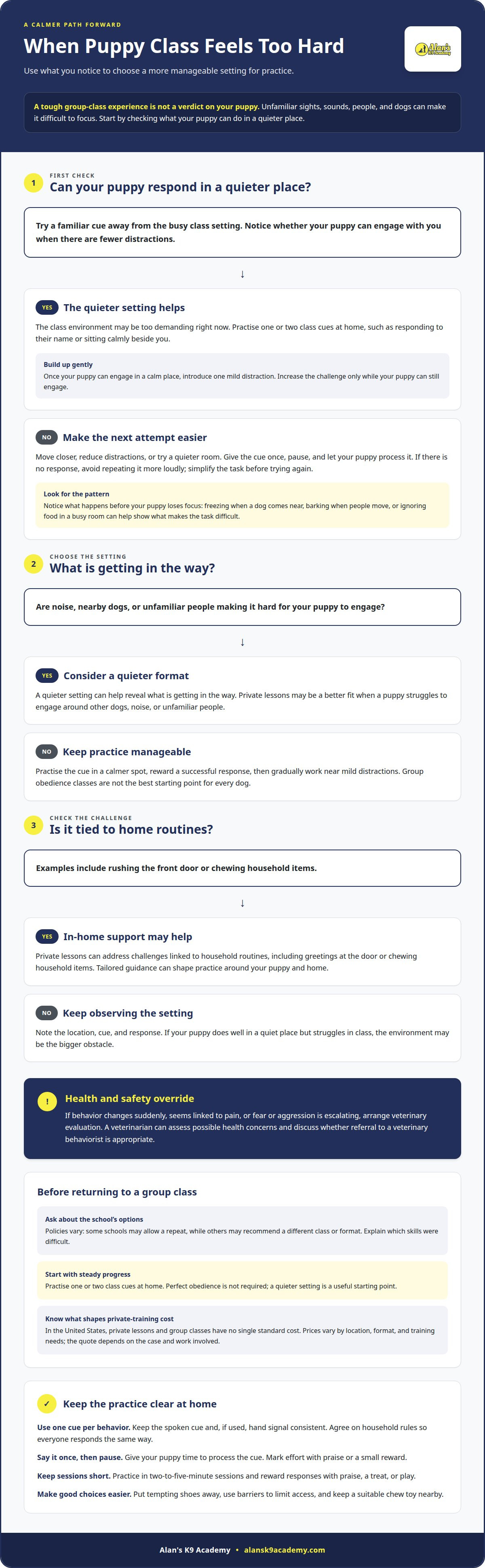
If your puppy doesn’t respond after a pause, don’t repeat the same instruction more loudly. Make the next attempt easier instead. For “come,” move closer, reduce distractions, or practise in a quieter room. For “down,” try a less distracting surface and reward a small movement toward the position. Give the cue once more when your puppy is ready to engage.
Notice what happens before and after each cue. If your puppy responds quickly in the kitchen but not near the front door, the busy setting may make the task harder. Return to a calmer spot, reward a successful response, then gradually practise near mild distractions. Make a brief note of the location, cue, and response to see where your puppy needs more support.
For personalized help identifying why a cue breaks down, individualized dog training guidance can help shape practice around your puppy’s behavior and home routine. The goal is a clear cue, a fair pause, and an easier next step when your puppy needs it.
3. In-home support for common puppy challenges
Home practice lets you work with the situations your puppy encounters every day. If your puppy mouths your hand, calmly pull away and offer a chew toy instead. Reward your puppy for choosing the toy. This gives them a clear alternative without turning play into a scolding or chase.
Make greetings low-pressure for a hesitant puppy. Ask visitors not to touch, talk to, or stare at the puppy at first. Once the puppy settles, visitors can get low and let the puppy approach and sniff. At the front door, use a gate or leash to prevent rushing while you reward calm behavior.
How can you tell whether your puppy needs a different class or private lessons? If noise, nearby dogs, or unfamiliar people make it hard for your puppy to engage, a quieter format can help reveal what’s getting in the way. Private lessons can also address challenges tied to home routines, such as greetings at the door or chewing household items.
In the United States, private puppy lessons and group classes don’t have one standard cost; prices vary by location, format, and training needs. The price depends on your case and is provided after a quote request, with factors such as session format and the work involved shaping the quote.
Practise at home regularly, making the environment easier while your puppy learns. Put tempting shoes away, use barriers to limit access, and keep a suitable chew toy nearby. Reward choices you want repeated with a treat, praise, or play. If a behavior keeps returning, note where it happens and what came before it. Those details can help tailor in-home training to your puppy’s routine.
4. Why do puppies fail puppy training class?
A puppy may struggle in class because the room demands attention amid unfamiliar sights, sounds, people, and dogs. A puppy watching every approaching dog may not notice a cue or treat. That doesn’t mean your puppy is untrainable; the setting may simply be too demanding right now. Group obedience classes aren’t the best starting point for every dog.
Notice what happens before your puppy loses focus. Do they freeze when another dog comes close, bark when people move, or ignore food in a busy room? These details can help distinguish distraction from worry or overstimulation. If your puppy responds in a quiet place but struggles in class, practise first with one mild distraction. Increase the challenge only while your puppy can still engage.
The class environment can affect you, too. If your puppy is pulling, barking, or trying to hide, it can be difficult to hear the instructor and remember the homework. After class, write down one skill you understood and one moment that felt difficult. For example, note whether your puppy could settle before the lesson or needed more distance from other dogs. Clear observations make the next step more practical.
A difficult class is information, not a final grade. Consider a calmer setting if your puppy repeatedly cannot focus, recover, or take rewards around the group. If your puppy can participate with more space and simpler exercises, a class may still become useful as skills develop. Start with engagement and confidence, then build toward busier surroundings at a pace your puppy can handle. For tailored help identifying a better starting point, get guidance for your puppy’s training needs.
Some owners choose to build familiarity at home first. One participant said they waited until their dog was about 4 months old and had established a bond and some training before trying puppy classes. A group can overwhelm or overstimulate a dog with dogs, people, and an unfamiliar environment, making it difficult to focus. If the dog is too worked up, an owner may miss the instructor’s guidance and be unclear about the homework. One participant advised that poorly run puppy classes may be worse than not attending classes; difficulty there is not proof a dog cannot learn.
Alan's K9 Academy: Group Classes
Alan's K9 Academy offers Group Classes for puppies ready to practise skills around other dogs and people. If your puppy struggled in a busy class, that experience can help clarify what support may fit next. In-Home Dog Training provides a more personalized setting for working through challenges in familiar surroundings, while Behavior Modification addresses behavior concerns that need focused support. The right starting point depends on what makes learning difficult for your puppy, such as distractions in a group or a challenge tied to home routines. Group practice can become a useful next step when your puppy is ready to engage around others. For help choosing a training path for your puppy, contact Alan's K9 Academy.
Choose a Next Step That Fits Your Puppy
A difficult class can help you identify what your puppy needs next. If you’re asking what to do when your dog failed puppy class, focus on a setting where your puppy can engage and the specific challenge you want to address. Personalized in-home training may suit skills that need attention at home. Group practice can come later, when your dog is ready to learn around others.
Alan's K9 Academy offers In-Home Dog Training and Behavior Modification for tailored training needs. Therapy & Service Dog Training is also available for families pursuing those distinct goals. Choose support that matches your puppy’s needs today, then build from there.
Contact Alan's K9 Academy to discuss a suitable next step. Your puppy’s path forward can start with one clear, manageable goal.
Frequently Asked Questions
What should I do after my dog fails puppy class?
Ask the instructor which skills or situations were difficult, then use that feedback to plan your next step. If your puppy struggled during greetings but managed quieter activities, focus on the conditions affecting participation rather than treating the class result as a pass-or-fail judgment. Keep a short record of what your puppy can do comfortably and what seems challenging.
How can I help a puppy who is shy, distracted, or reactive in class?
Give your puppy more space from whatever triggers the reaction, and don’t push closer to make them “get used to it.” A puppy watching other dogs from across the room may be able to take treats and reconnect with you there. If your puppy can’t settle or engage, pause outside the busy area and try again when they’re calmer.
What puppy training exercises can I practice at home between classes?
Try a simple “settle on a mat” exercise: place a mat in a quiet room, reward your puppy for stepping onto it, then gradually reward calm pauses. You can also practise name recognition by saying your puppy’s name during a quiet moment and rewarding a glance toward you. Keep distractions low at first, then practise near ordinary activity, such as someone walking through the room.