



Leash Reactivity Dog Training in Woodstock, Georgia
Leash reactivity isn’t simply a pulling problem. It can involve fear, anxiety, or aggressive behavior around dogs and people. A dog trainer for leash reactivity in Woodstock can help you address these responses with individualized training and behavior modification. The goal is to understand what dr...

Leash reactivity isn’t simply a pulling problem. It can involve fear, anxiety, or aggressive behavior around dogs and people. A dog trainer for leash reactivity in Woodstock can help you address these responses with individualized training and behavior modification. The goal is to understand what drives your dog’s reactions and build more manageable walking skills.
If walks feel tense or unpredictable, you’re not alone in wanting a calmer way forward. Reactivity can be stressful for you and your dog, but clear, consistent training can give you practical ways to respond and support better behavior.
This article explains how leash-reactivity training works, what may contribute to reactions, and how training can address pulling, fear-based responses, anxiety, and aggressive behavior around dogs or people. You’ll also learn what to consider when choosing a training approach in Woodstock and what a personalized plan may involve, so you can make an informed next move for your dog.
Key Takeaways
• Leash reactions can have different triggers, so noticing what happens before and during an outburst can help guide a more useful training plan.
• Learn how behavior modification can build practical skills for safer, calmer interactions around dogs and people.
• Fear-based reactions and anxiety call for thoughtful training that helps your dog feel more comfortable while learning new responses.
• Pulling and reacting on leash are related challenges, but each may need its own training steps and practice in real-world settings.
• Explore what to consider when choosing dog training in Woodstock and how in-home support can address behavior in familiar surroundings.
Aggressive behavior around dogs or people
Growling, lunging, barking, and snapping can signal that a dog feels overwhelmed near people or other dogs. These behaviors call for careful attention, not punishment or forced greetings. For example, a dog that reacts when another dog approaches on a narrow sidewalk may need more distance before it can focus on its handler. A dog trainer for leash reactivity in Woodstock can help identify triggers and develop a practical training plan.
What should you look for in feedback about Woodstock dog trainers who work with leash-reactive dogs? The most useful accounts describe specific changes, such as a dog learning to pass another dog calmly or a handler gaining a clearer response plan. Look for details about communication, realistic practice, and how the plan addresses the dog’s behavior, rather than relying on broad praise alone.
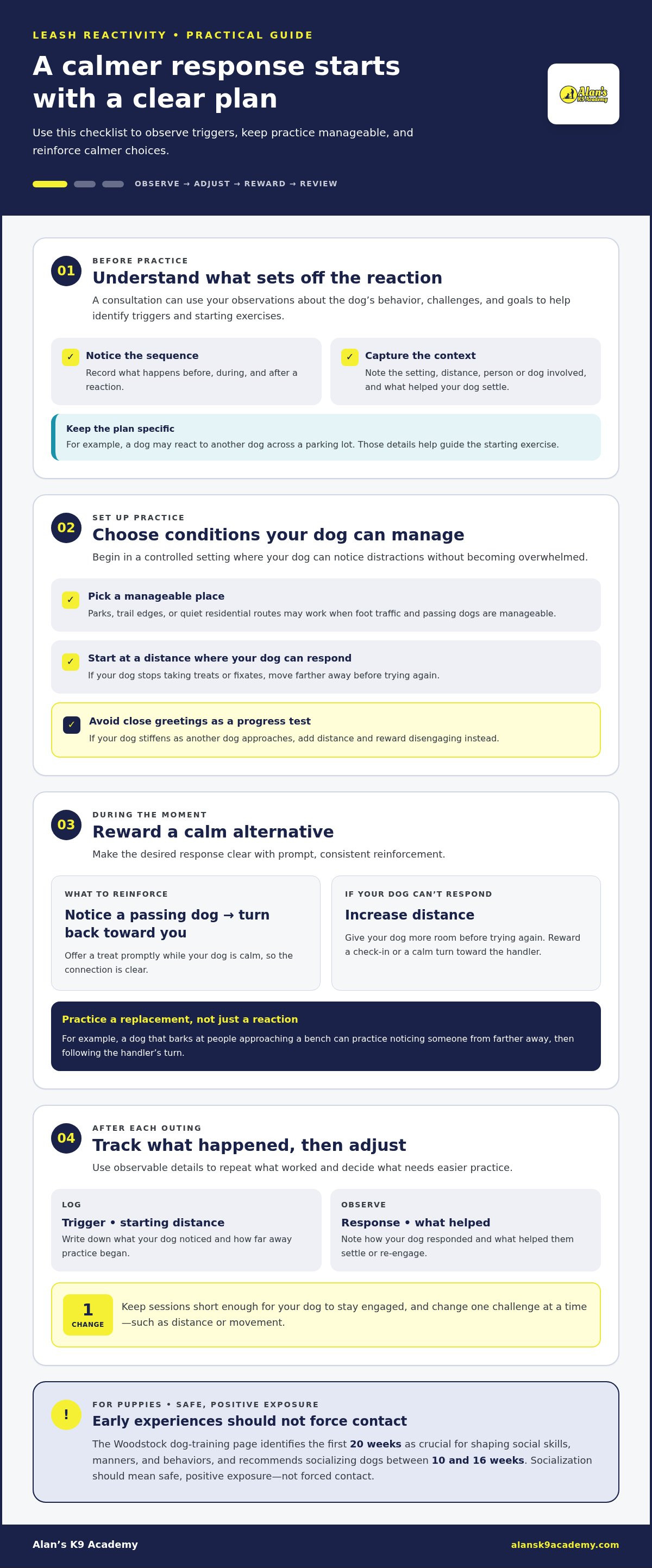
Aggression toward dogs or people can look different from one situation to another. A dog may bark at unfamiliar people near the front door yet remain relaxed with visitors outdoors. Another may react only when a stranger reaches toward its head. Record what happens before, during, and after each reaction. Note the setting, distance, person or dog involved, and what helped your dog settle. These observations make training more specific.
For aggressive dog training, the first steps should focus on preventing repeated reactions and teaching skills the dog can use instead. A handler can:
• Choose a quieter route when a busy path brings dogs too close.
• Turn away early when a person approaches within the dog’s reaction zone.
• Reward a check-in or calm turn toward the handler.
• Practice a simple change of direction before distractions appear.
Avoid arranging close greetings to “test” progress. For example, if a dog stiffens when another dog approaches, add distance and reward disengaging instead. Puppies also benefit from thoughtful early experiences: the Woodstock dog-training page identifies the first 20 weeks as crucial for shaping social skills, manners, and behaviors, and recommends socializing dogs between 10 and 16 weeks of age. Socialization should mean safe, positive exposure, not forcing contact.
Judge progress by observable behavior, not by one quiet walk. Track whether your dog notices a trigger sooner, responds to a cue, or recovers more readily after seeing someone. These details can help you adjust distance, timing, and practice conditions while keeping sessions manageable.
Training choices should reflect the individual dog and the behavior you observe. Professional credentials and proven titles in obedience and advanced handling demonstrate a trainer's dedication and skill. That is one concrete detail to consider alongside client descriptions of work with reactive dogs, communication, and practice plans at Alan's K9 Academy. It should not replace questions about how a trainer would manage your dog's particular triggers. Ask what the first sessions involve, how distance and safety are handled, and what signs indicate your dog is ready for a more challenging setup. A clear plan should allow you to slow down when your dog struggles, rather than treating proximity or silence as proof of progress.
Behavior modification
Behavior modification changes the pattern around a trigger, not just the visible response. A useful plan connects your dog’s behavior and surroundings with the handler’s next step.
Consultations and Behavior Evaluations
A consultation examines the dog’s behavior, challenges, and goals. Describe what happens before a reaction, such as spotting a dog across a parking lot, and what follows. The trainer can use those details to identify triggers and choose starting exercises. Woodstock dog trainers’ booking lead times depend on their schedules and the time needed to assess your dog’s needs, so plan around both.
Calm Behavior in Public
Public practice should start in a controlled setting where your dog can notice distractions without becoming overwhelmed. Woodstock parks, trail edges, or quiet residential routes may work when foot traffic and passing dogs are manageable. Begin at a distance where your dog can still respond to you. Move farther away if your dog stops taking treats or fixates.
Rewarding Calm Responses
Reward the behavior you want to see, such as looking at a passing dog and then turning back toward you. Offer a treat promptly while your dog is calm, so the connection is clear. If your dog can’t respond, increase the distance before trying again. Consistent timing helps make calm choices worthwhile during controlled practice and later in busier places.
Give each behavior-modification exercise a clear purpose. For example, a dog that barks at people approaching a bench can practice noticing someone from farther away, then following the handler’s turn. This sequence replaces a familiar reaction with a practiced alternative. Keep sessions short enough for your dog to stay engaged, and change one challenge at a time, such as distance or movement.
Track observable details after each outing: the trigger, your starting distance, the dog’s response, and what helped. If your dog stayed relaxed while a cyclist passed but reacted to a dog, those notes show which distraction needs easier practice. A written record also helps you repeat successful setups instead of guessing. For tailored behavior modification guidance, use the details from your walks to shape the next training steps.
Fear-based reactions and anxiety
A dog that barks, freezes, or pulls away may be responding to fear, not defiance. For example, a dog might tense when a stranger reaches toward its head, then bark when the person steps closer. Note the trigger, your dog’s body language, and the distance where the reaction begins. These details help distinguish a fearful response from excitement or frustration.
Anxiety can also appear before a trigger is close. A dog may scan the sidewalk, pant, refuse a treat, or try to turn home after hearing traffic. Look for patterns across places and situations, such as reactions near parked cars but not on a quiet path. Keeping a record helps you choose manageable practice conditions instead of asking your dog to cope with every distraction at once.
Training can pair a trigger with a positive experience while keeping your dog at a comfortable distance. If your dog notices a person and can still respond, offer a reward. Calmly create more space if tension rises. Don’t pull your dog toward the trigger or insist on a greeting. Short, controlled repetitions build a different response without making close contact the goal.
Telani Lasoleille says she and her mentor used positive reinforcement techniques to address her dog’s fear-based reactivity. A practical lesson is to reward small signs of confidence, such as looking at a passerby and turning back to the handler. You can use a simple sequence:
• Choose a quiet route with room to create distance.
• Notice the trigger before the dog becomes overwhelmed.
• Reward calm observation or a voluntary check-in.
• End the exercise or move farther away if tension increases.
Keep sessions predictable. For example, if a dog startles at a person opening an umbrella, begin farther away while the umbrella remains still. Reward calm observation, then adjust the setup gradually. If your dog stops eating or tries to escape, increase the distance and make the next repetition easier. A calm exit is a useful skill, not a training failure.
You may encounter the word “certified” when researching training credentials. Treat it as one detail to understand alongside the trainer’s approach to fear, the exercises used, and how progress is assessed. A useful plan identifies specific behaviors to practice, such as orienting toward the handler or moving away smoothly. Track those behaviors after each outing to see which settings support relaxed learning.
Leash reactivity and leash pulling
Leash reactivity may appear as barking, lunging, or pulling when a dog sees a trigger. Training addresses these responses and teaches practical leash skills for walks in Woodstock.
Force-Free and Reward-Based Methods
Reward-based training reinforces choices such as checking in, turning away, or walking with a loose leash. A useful plan keeps your dog at a distance where learning remains possible, then changes one challenge at a time. Ask how the trainer responds when a dog struggles, and look for clear examples of positive reinforcement rather than pressure or forced greetings.
Local training options include in-home dog training and group classes. In-home work lets a trainer address leash skills in familiar surroundings; group classes provide structured practice around other dogs. Choose the setting that fits your dog’s current ability to stay engaged.
Safe Walking Steps
In Woodstock, choose a route with room to turn around, and avoid narrow paths when other dogs approach. Keep the leash secure, scan ahead, and cross the street or create distance before your dog reaches its reaction point. Practice a quiet U-turn at home first, then use it outdoors when a trigger appears.
Bring rewards your dog will take, and keep walks focused on safe practice rather than covering distance. If a dog appears around a blind corner, calmly move behind a parked car or turn into an open area. Don’t let unfamiliar people or dogs approach for greetings.
Look for a trainer who can explain their approach to leash reactivity, demonstrate practical exercises, and adapt the plan to your dog’s behavior. A credential can be one detail to consider, but ask how the trainer builds skills, responds to distress, and coaches owners. Clear instructions matter because your timing and response shape each practice walk.
There’s no fixed session count or timetable for every dog. Progress depends on the triggers, the intensity of the response, your dog’s ability to recover, and consistent practice between sessions. Track changes such as walking past a dog at a manageable distance or responding to a turn cue. These learned skills are more useful progress markers than expecting a dramatic change after one walk.
During a session, practice one skill at a time: notice a trigger, create space, cue a turn, then reward your dog for following. If your dog cannot respond, make the next repetition easier by increasing distance or choosing a quieter route. For hands-on practice in familiar surroundings, in-home dog training can help work on leash skills where walks begin.
Dog training in Georgia and Woodstock
Leash-reactivity training in Woodstock should prepare you for the routes, encounters, and daily routines you actually face. A useful plan builds skills gradually, then applies them in realistic local settings.
What should you look for in a dog trainer in Woodstock, Georgia, who works with leash reactivity? Look for a trainer who addresses the reasons behind barking, lunging, or pulling and teaches handlers practical responses. Ask how sessions progress from manageable practice to real-world walks.
Local context matters because the same dog can respond differently across settings. A quiet residential street may offer more space than a crowded sidewalk, while a narrow path can make passing another dog difficult. Note what raises your dog’s stress: an approaching dog, a person emerging from a driveway, or a sudden turn near parked cars. These examples help shape training around your actual walking routine.
Begin with a simple route plan. Choose a familiar loop with room to turn, identify an open area for pauses, and note places where you can create distance. If a dog appears near a corner, cross the street or change direction before your dog fixates. Practice the turn at home first, then use it on a quiet Woodstock walk. These small decisions give you a repeatable response instead of requiring you to improvise under pressure.
Georgia’s varied everyday environments also make generalization important. A dog that walks calmly beside a familiar neighbor may still react to a jogger or another dog. Build practice around one new feature at a time: try a different route, then a moving distraction, then a busier setting. Keep familiar cues and rewards consistent as the surroundings change. That gives your dog a clear task as the environment becomes more challenging.
A private lesson can focus on your handling, your dog’s triggers, and the places you walk. Group practice may suit dogs who can already work at a comfortable distance from others. The setting should match your dog’s current behavior, not an ideal future outcome. For example, a dog that can’t take a treat near another dog needs easier practice before close group work.
For Woodstock dog owners, the clearest takeaway is to choose training that connects behavior work with everyday walks. Look for a plan that explains what to do before a reaction, how to create space, and what calm behavior to reinforce. Track one useful measure after each outing, such as whether your dog can turn away from a trigger. If stress rises, reduce the challenge and return to a familiar route. Practice should build usable skills, not simply expose your dog to harder situations.
Alan's K9 Academy: In-Home Dog Training
Alan's K9 Academy offers In-Home Dog Training and Behavior Modification for dogs whose leash reactions make everyday walks difficult. Working in familiar surroundings can help connect training to your dog’s routines and the situations you encounter locally. The academy uses balanced, humane methods, with training shaped around your dog’s behavior and your goals.
If your dog can practice calmly around other dogs, Group Classes may offer another setting for building skills. Therapy & Service Dog Training is also available for those pursuing that distinct training goal. Choose support based on the challenge you want to address, whether that’s reactions on walks or broader behavior needs.
For guidance with your dog’s leash behavior, contact Alan's K9 Academy to discuss training.
Make the Next Walk a Fresh Start
Your next step doesn’t need to be a perfect walk. Choose one skill to practice, such as turning away together when a trigger appears, and notice what helps your dog stay engaged. A dog trainer for leash reactivity in Woodstock can help turn those observations into a practical plan that fits your routine and your dog’s needs.
Alan's K9 Academy offers In-Home Dog Training and Behavior Modification for challenges that affect everyday life. If your goals extend to a different kind of partnership, the academy also provides Therapy & Service Dog Training. Each path serves a distinct need, so focus on the support that matches what you and your dog are working toward.
When you’re ready to discuss a thoughtful next step, contact Alan's K9 Academy. Small, consistent skills can help make future walks feel more manageable for both of you.
Frequently Asked Questions
What should I expect during a first consultation for leash-reactivity training?
Expect to discuss your dog’s behavior, challenges, and training goals so an evaluation can guide a suitable plan. Bring examples of situations that concern you, such as reactions near home or during greetings, and describe your usual walking routine. You can also note cues your dog already knows. Acceptance into a program and the recommended training plan are determined through an evaluation.
Which dog behaviorists near Woodstock, Georgia use force-free or reward-based methods for leash reactivity?
Telani Lasoleille and her mentor used positive reinforcement techniques to address her dog’s fear-based reactivity.