



How to Choose a Dog Trainer by Evaluating Methods and Credentials
A credential alone won’t tell you how a trainer will treat your dog. When deciding how to choose a dog trainer, look for humane, clearly explained methods, experience relevant to your dog’s needs, and a willingness to involve veterinary or behavior professionals when appropriate.It’s reasonable to w...

A credential alone won’t tell you how a trainer will treat your dog. When deciding how to choose a dog trainer, look for humane, clearly explained methods, experience relevant to your dog’s needs, and a willingness to involve veterinary or behavior professionals when appropriate.
It’s reasonable to want an expert who can help with real challenges, from leash reactivity to everyday manners, while keeping your dog’s wellbeing central. Assess the trainer’s approach, relevant qualifications, and whether professional referrals or collaboration may be appropriate.
Consider what happens during a session and whether the trainer teaches you how to work with your dog, not just handles the dog themselves. These criteria can help you choose support that builds safer, more consistent progress at home and in everyday settings.
Key Takeaways
• Look for a trainer who explains how dogs learn and adapts lessons to your dog’s specific behavior and comfort level.
• Compare credentials with relevant hands-on experience, continuing education, and the trainer’s ability to teach you practical skills.
• Notice how the trainer handles questions, mistakes, and signs of stress, and whether they know when collaboration with a behavior or veterinary professional is appropriate.
• Choose a training format that suits your dog and household, then focus on clear communication and consistency in everyday practice.
1. Referrals to veterinary and behavior professionals
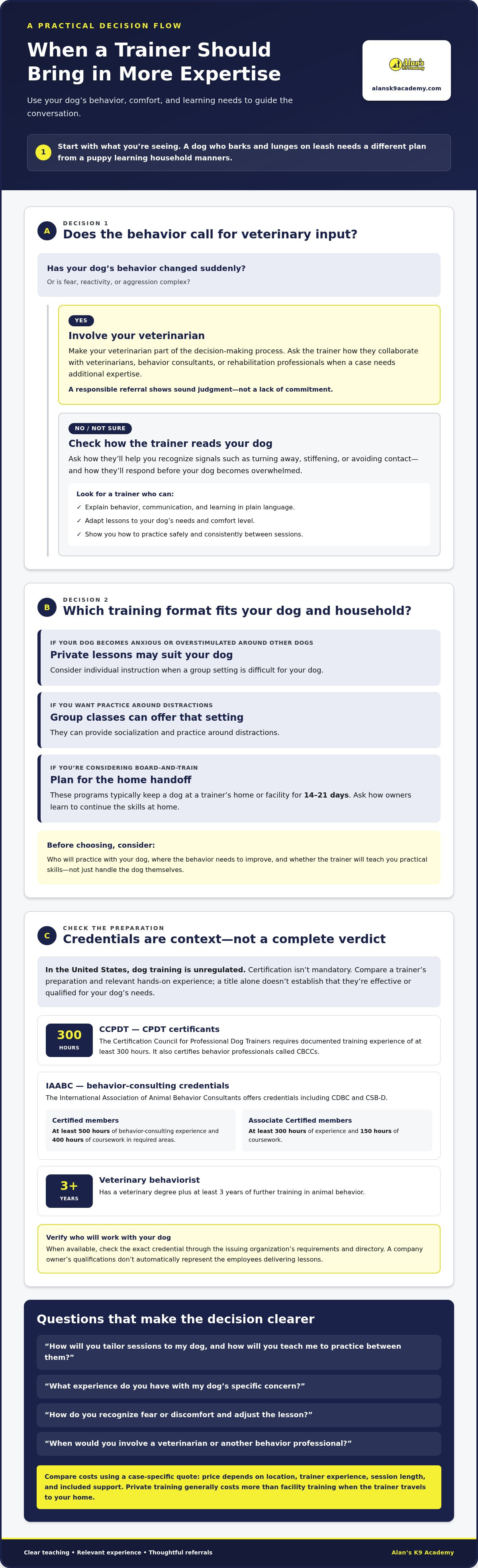
Choose a trainer who can explain how dog behavior, communication, and learning shape each lesson. Ask how they’ll help you recognize signals such as turning away, stiffening, or avoiding contact, and respond before your dog becomes overwhelmed. A dog who barks and lunges on leash, for example, needs a different plan from a puppy learning household manners. Clear instruction helps you practice safely and consistently between sessions.
Ask about education in canine behavior, hands-on experience, and continuing professional development. Dog training is unregulated in the United States, so credentials and experience can help you assess a trainer’s preparation, but neither replaces a clear conversation about your dog. A professional should explain the training plan in plain language, including how positive reinforcement supports desired behavior and how lessons build beyond basic obedience. Look for someone who can describe their expertise and explain when another professional should be involved.
A veterinary behaviorist has a veterinary degree plus at least 3 years of further training in animal behavior. If your dog’s behavior changes suddenly, or fear, reactivity, or aggression is complex, involve your veterinarian as part of the decision-making process. Ask a prospective trainer how they work with veterinarians, behavior consultants, or rehabilitation professionals when a case needs additional expertise. A responsible referral shows sound judgment, not a lack of commitment.
Match the training format to your dog and your goals. Group classes can offer socialization and practice around distractions; private lessons may suit dogs who become anxious or overstimulated around other dogs. Board-and-train programs typically keep a dog at a trainer’s home or facility for 14–21 days, so ask how owners learn to continue the skills at home. Consider who will practice with your dog and where the behavior needs to improve.
For private lessons, group classes, and board-and-train, costs depend on location, trainer experience, session length, and included support. Private training generally costs more than facility training when the trainer travels to your home; request a case-specific quote to compare formats. Before choosing, describe your dog’s specific concern, such as crate training, barking, or leash reactivity, and ask what experience and professional referrals fit that need.
2. Dog trainer certifications and credentials
In the United States, dog training is an unregulated industry. A trainer can charge for services regardless of education, experience, or credentials, so assess each person’s preparation rather than relying on a title alone. Certification isn’t mandatory, but it can indicate professional commitment and interest in continuing education.
The Certification Council for Professional Dog Trainers (CCPDT) requires CPDT certificants to document at least 300 hours of training experience. It also certifies behavior professionals called CBCCs. The International Association of Animal Behavior Consultants (IAABC) offers credentials including CDBC and CSB-D. IAABC Certified members have at least 500 hours of behavior-consulting experience and 400 hours of coursework in required areas. Associate Certified members have at least 300 hours of experience and 150 hours of coursework.
Credentials offer useful context, not a complete verdict. Certification alone doesn’t establish that a trainer is effective or qualified for your dog’s needs. Ask how their education and experience relate to your goals, such as loose-leash walking, manners, or behavior modification. Ask what methods they use, how they keep their knowledge current, and what continuing education they pursue through courses, conferences, research, or mentorship.
When available, verify credentials through the issuing organization’s requirements and directory. Check the exact credential and who holds it: a company owner’s qualifications don’t automatically represent the employees working with your dog. If several trainers deliver lessons, ask about the assigned trainer’s own experience and education.
Then connect credentials to what you observe: can the trainer explain a technique clearly and show how it helps you teach your dog? For personalized instruction at home, explore in-home dog training as one option for practicing skills in your everyday setting.
3. What qualifications should you look for in a dog trainer?
Build a shortlist using trusted referrals and professional directories. Ask your veterinarian or veterinary staff for local recommendations, then compare names with the Certification Council for Professional Dog Trainers directory or the Association of Professional Dog Trainers’ trainer search. Friends, family, responsible breeders, shelters, and rescue groups can also suggest trainers familiar with particular dogs or behavior concerns.
Look beyond a directory listing. Ask whether the trainer has worked with your dog’s specific needs, such as leash reactivity, excessive barking, or puppy manners. Ask about animal behavior education, hands-on experience, affiliations, and continuing learning. A responsible trainer can describe their qualifications and explain when another professional should join the plan. Request client references, read online comments, and look for details about communication and lesson structure. When deciding how to choose a dog trainer, consider how closely their experience matches your dog’s needs.
Because dog training is unregulated in the United States, don’t assume a state or city license establishes a trainer’s qualifications. Compare credentials, relevant experience, and training practices directly. To choose the right trainer for your situation, focus on who will work with your dog and how they’ll guide your household.
Before hiring, ask: “How will you tailor sessions to my dog, and how will you teach me to practice between them?” Ask how the trainer recognizes fear or discomfort and adjusts the lesson. If possible, observe a class in person and notice whether the trainer explains techniques clearly and handles dogs thoughtfully.
Assess the setting, too. During a class visit, look for cared-for dogs, a clean and organized facility, and comfortable interactions among students, dogs, and trainer. Ask about insurance, safety procedures, client expectations, cancellation policies, and written business terms. These details clarify how sessions are managed if plans change.
Read the contract before agreeing, including its refund terms, cancellation rules, and what services or follow-up it covers. Make sure the written expectations match your conversation. If classes aren’t a suitable setting for your dog, ask about private training at home or elsewhere; the right format depends on your dog’s comfort, behavior, and learning needs.
4. What methods will they actually use to train your dog?
Ask the trainer to describe a typical lesson, not just label their methods “balanced” or “science-based.” Request examples of what they do when a dog succeeds, makes a mistake, or shows discomfort. For instance, ask what happens if your dog ignores a recall cue or stops taking treats. A clear answer should explain how the trainer adjusts the exercise and helps you understand your dog’s response.
Positive reinforcement rewards a behavior the trainer wants to see, such as your dog checking in during a walk. Ask what reward they might use, how they’ll build the behavior gradually, and how you’ll practice it in daily life. A professional should explain the purpose of each step instead of relying on a label or expecting you to follow instructions without context.
Ask how the trainer applies LIMA, which stands for least intrusive, minimally aversive. The Association of Professional Dog Trainers International’s standards of practice have been in line with the AVSAB position statement since 2022. The CCPDT updated its guidelines in 2025, and those guidelines still allow aversives such as shock and prong collars in some circumstances. A credential alone therefore doesn’t tell you exactly which tools or techniques a trainer will use.
Ask directly whether training may involve leash corrections, prong collars, or shock collars, and what alternatives the trainer considers. Ask how they respond to fear, avoidance, or frustration, too. If you observe a session, notice whether the trainer is patient, explains each exercise, and gives the dog room to recover when overwhelmed. If observation isn’t possible, ask for a clear description of how sessions work.
Alan's K9 Academy uses balanced, humane methods. If personalized practice at home fits your dog’s needs, explore in-home dog training options and ask how the training approach supports your goals.
Alan's K9 Academy: In-Home Dog Training
Alan’s K9 Academy offers personalized in-home dog training for owners who want to work on skills where everyday challenges happen. Practicing in your home can help connect training to routines such as greeting visitors, settling indoors, or walking through the neighborhood. For fear, reactivity, or other challenging behavior, Behavior Modification provides a focused training option. Group Classes may suit dogs who can learn around other dogs, while Therapy & Service Dog Training supports those specialized training goals.
Programs use balanced, humane methods and are tailored to the dog and household. You’ll take part in the process, building practical skills you can reinforce between sessions. If you’re ready to discuss a training path for your dog, contact Alan’s K9 Academy.
Turn Your Evaluation Into a Practical Next Step
Choose training that helps you and your dog build skills together in the settings that matter. Before beginning, identify a shared goal, such as calmer greetings at home or more confidence during daily walks. This gives your first conversation a clear starting point and helps you explain what support would be useful.
If you’re considering how to choose a dog trainer for a specific challenge, think about the format that fits your household and your dog’s needs. Alan's K9 Academy offers In-Home Dog Training, Behavior Modification, and Therapy & Service Dog Training. You can discuss which direction best matches your goals and what taking part in the training will look like.
Training is a partnership, built through thoughtful instruction and practice in everyday life. Contact Alan's K9 Academy today to talk about a suitable next step for you and your dog. A clearer plan can help you move forward with confidence.
Frequently Asked Questions
What methods will they actually use to train your dog?
Ask for a step-by-step example using a skill your dog needs, such as staying calm when the doorbell rings. Find out what the trainer will reward, how they’ll respond if your dog struggles, and how you can practice between lessons. A useful explanation connects each technique to your dog’s behavior and gives you a clear role in building the skill at home.
What qualifications should you look for in a dog trainer?
Look for preparation that fits your dog’s needs, not just an impressive title. A trainer supporting a dog who reacts to visitors, for example, should be able to describe relevant experience and how lessons involve the household. Ask who will work directly with your dog, how they’ll teach you to practice, and whether they can explain their approach in language you understand.
How much experience do you have?
Alan Carr has over 35 years of professional dog-training experience. To understand how that experience relates to your situation, describe your dog’s age, daily routine, and main challenge. For example, ask how the trainer would approach a young dog that jumps on guests differently from an adult dog struggling to settle. Specific examples help you judge whether their background matches your training goals.
What about continuing education for dog trainers?
Continuing education helps trainers keep learning about canine behavior and evolving training practices. Ask what they’ve studied recently and how that learning shapes their work with dogs and owners. Courses, conferences, research, and mentorship are ways professionals can develop their knowledge. Listen for a specific explanation, such as how they adapt a lesson when a dog shows stress or confusion.
Are you certified?
Alan Carr is identified as a Master K9 Trainer. When comparing this title with another credential, look at the exact credential name and what the issuing organization requires. A title and a certification from a professional organization aren’t automatically interchangeable. Ask which qualifications apply to the trainer who will guide your dog, and consider them alongside relevant experience and the way training is explained.
Can I contact a few of your customers?
Customer contact should respect each person’s privacy and require their permission. Public testimonials from AJ Wilson and Joshua Davis offer named customer perspectives on their experiences. As you read them, note what each person says about communication, the training process, and their dog’s progress. Those details can help you identify useful questions about the support and instruction you’re looking for.