



How to build off-leash reliability with progressive training
What if your dog’s age isn’t the main barrier to off-leash progress? A dog isn’t automatically too old to begin; puppy engagement foundations can start at 8 to 12 weeks in a controlled environment. For maintaining off-leash reliability training, the key is progressing at your dog’s pace and building...

What if your dog’s age isn’t the main barrier to off-leash progress? A dog isn’t automatically too old to begin; puppy engagement foundations can start at 8 to 12 weeks in a controlled environment. For maintaining off-leash reliability training, the key is progressing at your dog’s pace and building consistent responses before reducing leash support.
It’s understandable to want more freedom while still feeling confident your dog will respond when distractions compete for attention. This guide explains how maintaining off-leash reliability training can be tailored to your dog’s age, practice settings, and leash skills. You’ll learn how training can progress from on-leash responses to long-line practice and, when your dog is ready, carefully managed off-leash work.
Key Takeaways
• A dog’s age alone doesn’t determine readiness; a trainer considers experience, temperament, and how consistently your dog responds to cues.
• Reliable recall, stop, leave-it, and drop-it cues help a trainer assess safety before adding more freedom.
• Training settings should become more challenging gradually, with the environment adjusted if distractions interfere with your dog’s focus.
• Leash and long-line work can show where your dog is ready to progress, while professional guidance helps determine whether a remote training collar fits the plan.
Is my dog too old to begin professional off-leash training?
No. A trainer can tailor the plan to your dog’s age, experience, and response to cues. Follow local leash laws, and practice off leash only where it’s safe and permitted.
•
Build the Core Cues With a Trainer
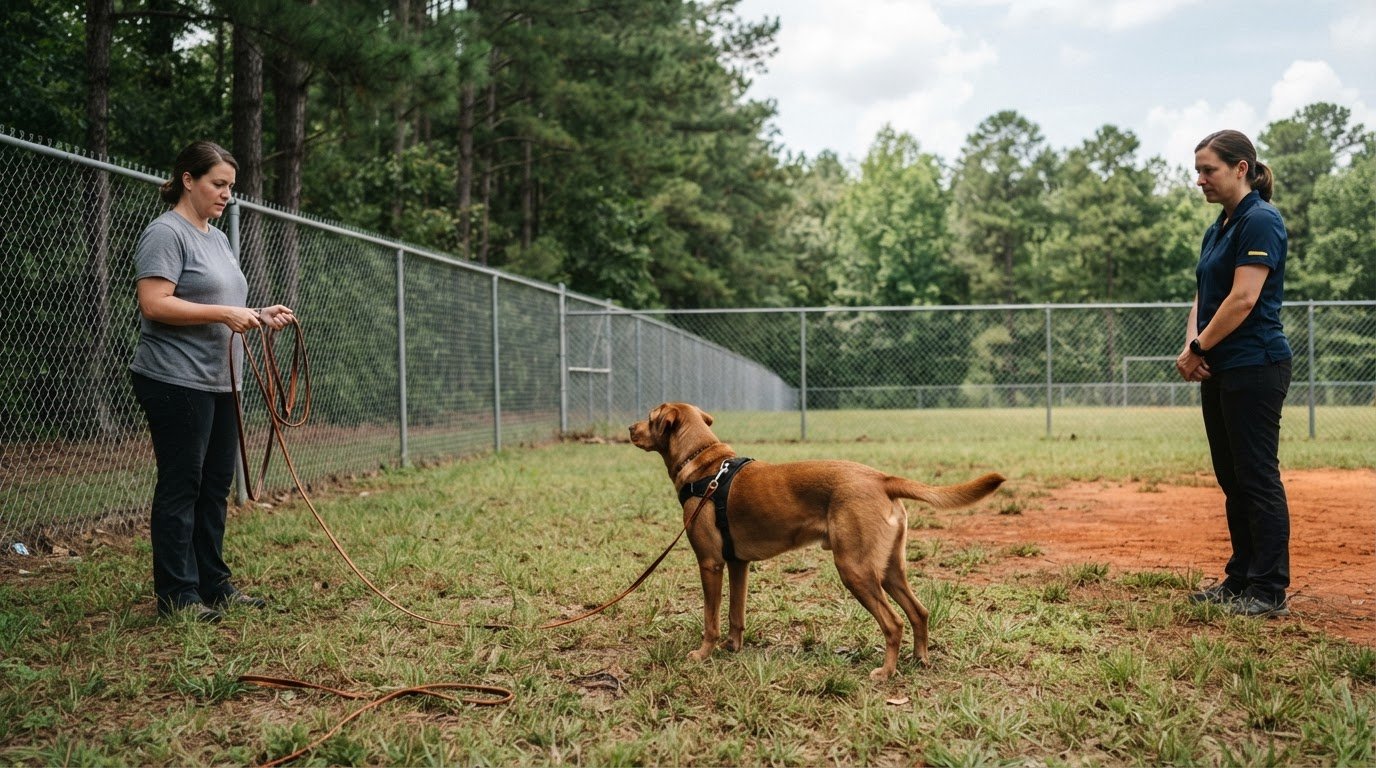
Have a trainer assess recall, stop, “leave it,” and “drop it” first in a controlled, fenced setting. The dog should respond to a cue consistently before training adds distance or distractions. A recall readiness check can include coming from 20 feet away. To rebuild reliability after ignored commands, return to an easier setting and reinforce the cue there before raising the challenge. Avoid testing these skills where a missed response could put your dog at risk.
•
Reward Timely Recalls
Have the trainer mark the moment your dog turns toward you, then reward the arrival with praise, treats, or play. Clear timing helps your dog connect the response with its reward. Repeating a recall cue before following through can teach a dog that the first cue doesn’t matter, so practice should be set up for success from the start. If your dog has begun ignoring cues, the trainer can reduce distractions, rebuild reliable responses, and gradually increase the difficulty. Recall shouldn’t always end the fun: sometimes your dog can return to play after responding.
•
Monitor Body Language and Teach Emergency Recall
Have the trainer watch for signs of stress, fear, or overstimulation before increasing difficulty. A tense posture or trouble focusing can signal that the setting is too challenging; return to a calmer, controlled space. The trainer can pair a distinct emergency recall or stop cue with strong rewards, practicing first where the dog can respond safely. Puppy foundations can begin at 8 to 12 weeks, while puppies may start exploring more at 14 to 16 weeks. Since many dogs aren’t fully mature until 2 to 3 years, age informs the plan but doesn’t set a cutoff.
How does a trainer introduce off-leash training in busy places?
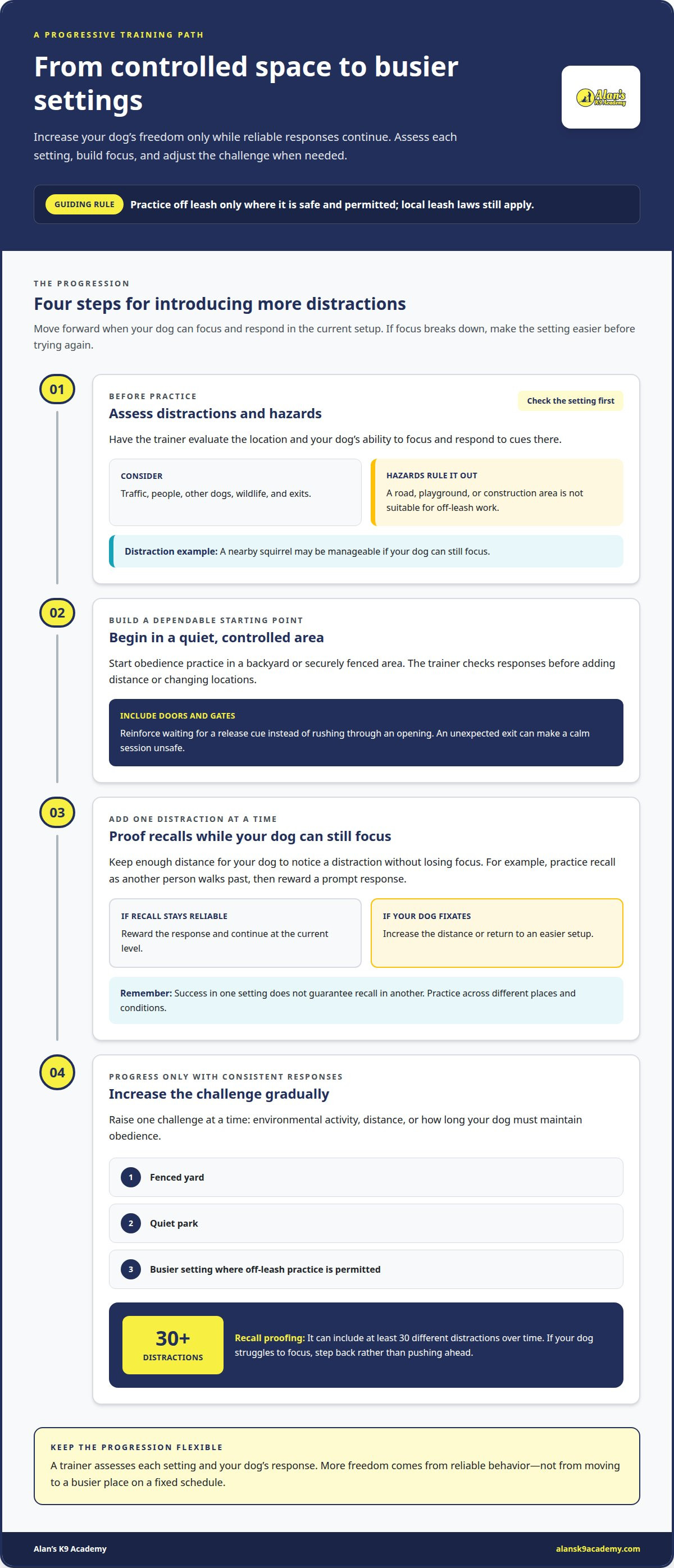
A trainer assesses each setting before increasing your dog’s freedom. Practice progresses from controlled, low-distraction situations to busier ones only while your dog continues to respond reliably.
•
Assess Distractions and Hazards
Have the trainer assess the location before practice, considering traffic, people, other dogs, wildlife, and exits. A squirrel nearby may be a manageable distraction; a road, playground, or construction area presents hazards that rule out off-leash work. The trainer also observes whether your dog can focus and respond to cues in that setting. Local leash laws still apply, so practice off leash only where it’s safe and permitted.
•
Begin in Low-Distraction Areas
Begin obedience practice in a quiet, controlled place, such as a backyard or securely fenced area. The trainer checks your dog’s responses there before increasing the distance or changing locations. Doors and gates need practice too: the trainer can reinforce waiting for a release cue rather than rushing through an opening. This skill matters because an unexpected exit can quickly make a calm session unsafe.
•
Proof Recalls Around Distractions
Ask the trainer to introduce distractions one at a time, keeping enough distance for your dog to notice them without losing focus. For example, practice recall as another person walks past, then reward a prompt response. If your dog fixates on the distraction, the trainer can increase the distance or return to an easier setup. Success in one setting doesn’t guarantee recall in another, so practice needs to include different places and conditions.
•
Increase Distractions Gradually
Have the trainer raise one challenge at a time, such as environmental activity, distance, or how long your dog must maintain obedience. A progression might move from a fenced yard to a quiet park, then to a busier permitted setting. Recall proofing can include at least 30 different distractions over time. If your dog struggles to focus, step back rather than pushing ahead. Professional off-leash training guidance can help shape that progression.
Remote training collar use and professional guidance
A remote training collar can support communication at a distance, but it can’t create understanding by itself. A professional first evaluates your dog’s existing cues, behavior, and training goals before deciding whether the tool belongs in a plan.
Assess the foundation before using a collar.
Have the professional confirm your dog understands the cue and responds reliably without relying on a device. A collar should support an established training system, not replace clear instruction or practice. The professional can assess how your dog responds in a controlled setting, such as a backyard, before adding distance or distractions.
Set clear goals for distance work.
A remote training collar can be used to communicate with a dog at a distance of fifty yards. The professional determines whether distance is relevant to your goals and teaches you how the cue fits into the wider plan. If your dog doesn’t understand the behavior at close range, adding distance won’t solve that gap.
Build a practical long-term plan.
Practice frequency and session length depend on your dog’s focus, stress signals, current progress, and the skills being developed. Sessions should stay relatively short and end on a successful note when possible. The professional can adjust the schedule as your dog improves, then use a training log to track responses and identify setbacks.
Seek guidance when progress stalls.
If your dog stops responding, becomes overstimulated, or struggles to listen around distractions, the professional can lower the challenge and rebuild the behavior. Age, temperament, breed, and previous experiences can all affect progress. Off-leash mastery may take several weeks of consistent practice, and rewards remain useful over the long term. Customized professional support can help owners maintain skills across real-life situations.
Progressive leash and long-line training with a professional
A trainer uses leash work to assess your dog’s skills before increasing freedom. Maintaining off-leash reliability training means extending familiar behaviors to settings with gradually fewer controls, not removing the leash all at once.
Confirm the on-leash foundation.
The trainer checks basic obedience and whether your dog responds consistently to recall while leashed. A history of walking on a six-foot leash alone may not prepare a dog for off-leash challenges. The professional also observes behavior, focus, and how quickly your dog turns toward you when called. This reveals which skills need reinforcement before adding distance.
Introduce a long line for controlled exploration.
A long training line lets your dog explore while the handler maintains safety during recall practice. The trainer observes whether your dog comes when called with more room to move. If the response weakens, the professional adjusts the difficulty rather than letting the dog rehearse ignoring the cue. Treats or play can reward successful returns and help keep the dog engaged.
Build distance and radius gradually.
In a fenced area, a trainer may begin radius work with a 10-to-15-foot leash. As the dog moves within the training radius, the handler can change direction when the dog is 10 feet away within a 12-foot radius. This teaches the dog to notice and follow the handler rather than waiting to be called every time. Distance increases only while the dog stays engaged.
Test skills before reducing restraint.
The trainer progresses from leash to long line, then controlled low-distraction practice, and later more open environments. Off-leash heeling starts on leash before transitioning gradually. If your dog ignores commands on the long line, the trainer keeps the dog leashed or in a safely secured area. This progression supports maintaining off-leash reliability training across changing conditions.
Alan's K9 Academy
Alan's K9 Academy helps you build a training plan around your dog’s current skills, age, and everyday challenges. If recall is inconsistent, distractions interrupt progress, or you’re unsure when to move from a long line to more freedom, professional guidance can help identify the next appropriate step. In-Home Dog Training and Behavior Modification provide options for addressing individual training goals, while Group Classes offer a structured setting for practicing around other dogs. Therapy & Service Dog Training supports separate working-dog goals.
Choose professional support when you need a clearer progression, hands-on instruction, or help adapting practice to your dog’s responses. Contact Alan's K9 Academy to discuss your dog’s off-leash training needs.
Build the next stage of your dog’s freedom
Off-leash progress isn’t a finish line. It’s an ongoing partnership between you and your dog, shaped by changing environments, new distractions, and the skills you want to use together. A plan for maintaining off-leash reliability training should help your dog respond beyond familiar practice settings and give you a clear way to adjust as circumstances change.
Consider what would make everyday outings feel more manageable: a stronger response around wildlife, calmer transitions through gates, or confidence practicing in a new place. Bring those priorities to a professional so the next steps reflect your dog’s real behavior and your goals. Discuss your training goals with Alan's K9 Academy and explore a practical path forward. Consistent, thoughtful work can help you and your dog enjoy more freedom together.
Frequently Asked Questions
How long does it take to achieve 100% off-leash reliability?
No training plan can promise 100% reliability in every situation. Off-leash mastery typically takes several weeks of consistent practice, and dogs still need long-term reinforcement. Progress depends on factors such as temperament, age, previous experiences, and how well your dog responds as settings change. A trainer can use a practice log to spot patterns, like missed recalls near wildlife, and adjust the plan.
Can every dog learn to be off leash?
Dogs differ in temperament, breed, age, and experience, so the same off-leash goal won’t suit every dog or setting. A professional evaluates the dog’s behavior and response to cues before recommending an appropriate plan. For some dogs, reliable skills on leash or in secure spaces may be the safer everyday choice. The level of freedom should reflect your dog’s demonstrated responses and the environment.
Can high-prey drive breeds like Huskies or Terriers ever be trusted off-leash?
Breed alone doesn’t determine whether a dog is ready; individual behavior and responses to distractions matter. A trainer can assess whether your dog can disengage from movement, such as a nearby squirrel, and turn attention back to you. If chasing overrides cues, use a leash or secure area instead of testing freedom in an exposed location. Progress depends on the dog’s behavior, not its breed label.
What are the risks of walking off leash?
An off-leash dog may chase wildlife, approach unfamiliar dogs or people, or move beyond your control near hazards. A reliable recall reduces risk but can’t prevent every unpredictable situation. Follow local leash rules, and choose only places where off-leash activity is permitted and safe. Keep your dog restrained around roads, livestock, and other settings where a sudden chase or approach could create danger.
What information and equipment should I provide to get started with professional training?
Share your dog’s age, temperament, previous training, behavioral concerns, and your goals. Give examples of where cues work well and where responses break down, such as returning indoors but not from the yard. Bring the leash or training line you use, if applicable, and mention any training tools already involved. The trainer can assess your setup and guide equipment choices.
What if my puppy already has a perfect recall?
Treat an early recall as a valuable foundation, not proof that it will work in every setting. A puppy that comes readily indoors may respond differently around moving wildlife, visitors, or an open gate. Keep practice in safe, controlled places and reward the response as your puppy grows. A professional can assess whether the behavior carries over to new situations before recommending greater freedom.