



Dog Trainer for Rescue Dogs in Dallas, GA: A Supportive Path Forward
What if your rescue dog’s next step has less to do with its past and more to do with what it needs today? It’s natural to wonder whether earlier experiences are behind fear, reactivity, or difficulty settling in. But assumptions won’t tell you what your dog is ready to learn. A dog trainer for rescu...

What if your rescue dog’s next step has less to do with its past and more to do with what it needs today? It’s natural to wonder whether earlier experiences are behind fear, reactivity, or difficulty settling in. But assumptions won’t tell you what your dog is ready to learn. A dog trainer for rescue dogs Dallas GA can help you focus on the dog in front of you and build communication one practical skill at a time.
Adjusting to a new home takes patience. You may be establishing routines, learning to read your dog’s signals, and building confidence together. Personalized In-Home Dog Training can address communication and everyday skills where you live, while Behavior Modification offers individualized support for challenges such as anxiety and reactivity.
At Alan’s K9 Academy, Master Trainer Alan Carr brings over 35 years of professional dog-training experience to customized training. Acceptance into a program and the recommended training plan are determined through an evaluation. This article explains how to assess your rescue dog’s current needs, build useful home and real-world skills, and take a clear next step toward a stronger partnership.
Key Takeaways
• Rescue-dog training works best when it responds to your dog’s current behavior and needs, not assumptions about its past.
• Predictable routines, clear communication, positive reinforcement, and appropriate tools can help structure practice at home.
• Compare In-Home Dog Training, Group Classes, and Behavior Modification to understand which approach may fit different goals.
• A dog trainer for rescue dogs Dallas GA can help you build practical skills through individualized guidance and an evaluation-led process.
• The first steps are straightforward: describe your main concern, share relevant examples, and review training recommendations.
Rescue Dog Trainer in Dallas, GA | Start Training Today
A newly adopted dog can bring plenty of questions: What does that bark mean? Is a busy street too much for a walk right now? Which routines will help everyone settle in? You don’t need to solve everything at once. A dog trainer for rescue dogs Dallas GA can help turn daily observations into practical training priorities. Start with the behavior you see today, then practice useful skills in the places they matter.
That might mean teaching your dog to settle while the household is active, building a more reliable response to a cue, or recognizing when a situation is too difficult. Training is a partnership: your observations, your dog’s responses, and a trainer’s guidance all shape the work. The principles of dog training offer helpful background, but your dog’s plan should reflect the individual in front of you.
Why a rescue dog’s history is not the whole story
Rescue status doesn’t prove a dog has experienced trauma, feels fearful, or has behavior problems. A dog’s past may be partly unknown, but it shouldn’t become a prediction. Age and breed alone don’t define learning potential, either. Training priorities are best based on what you can observe now and what you want daily life to look like.
Notice when your dog seems comfortable, what situations prompt barking or pulling, and which routines are already working. For example, record whether barking happens at the window, when the doorbell rings, or during a walk. These details help identify priorities without labeling your dog or guessing at its history.
An evaluation should come before a training plan, because recommendations need to fit your dog’s observed behavior, household routines, and goals. At Alan’s K9 Academy, acceptance into a program and the recommended training plan are determined through an evaluation.
What Dallas-area owners may want help with
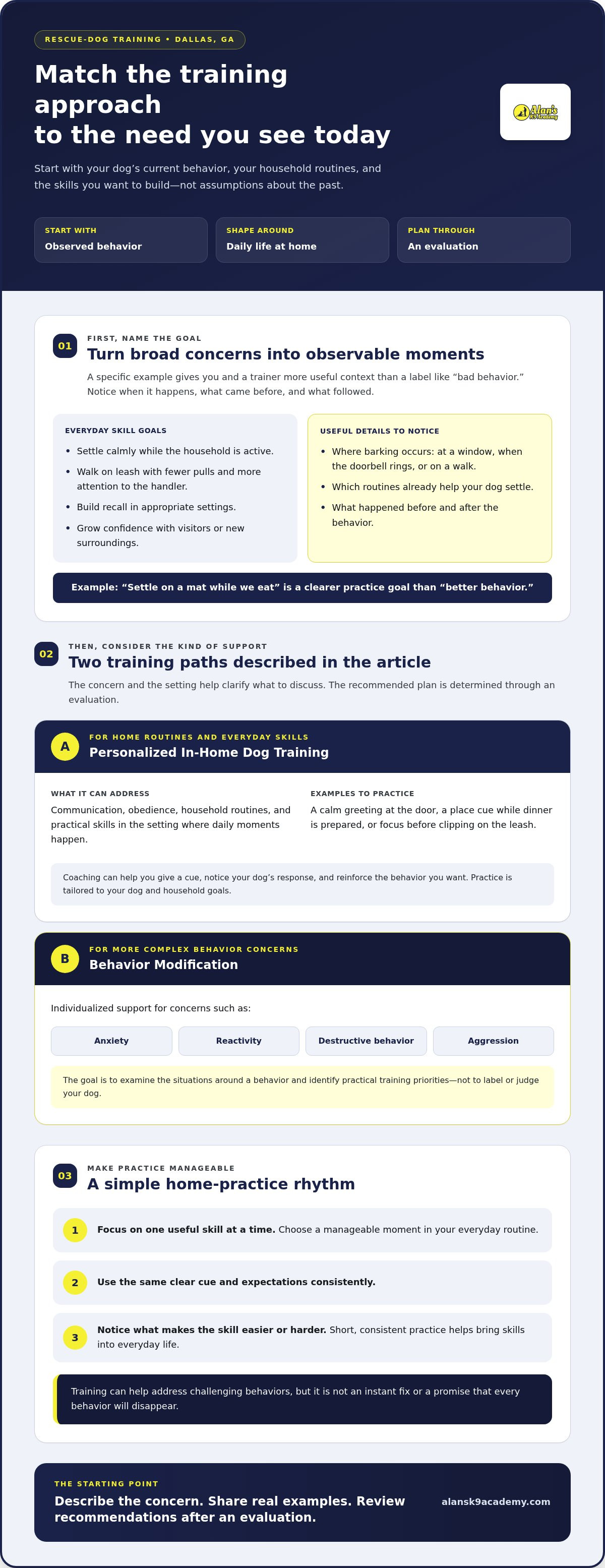
Start with specific moments in your day. “Better behavior” can be hard to measure; “settle on a mat while we eat” gives you a clear skill to practice. In Dallas and nearby Paulding County, owners may want support with goals such as:
• Settling more calmly at home while the household is active.
• Walking on leash with fewer pulls and more attention to the handler.
• Building recall so the dog responds when called in appropriate settings.
• Growing confidence during ordinary experiences, such as meeting visitors or encountering new surroundings.
These are general obedience and life-skill goals. Concerns such as anxiety, reactivity, or aggression may call for Behavior Modification, which provides individualized support for more complex behavior challenges. The distinction isn’t a judgment about your dog; it helps clarify what kind of guidance may fit the concern. Bring concrete examples, including what happened before and after the behavior, so training priorities can be discussed in context.
How Rescue-Dog Training Builds Communication at Home in Dallas
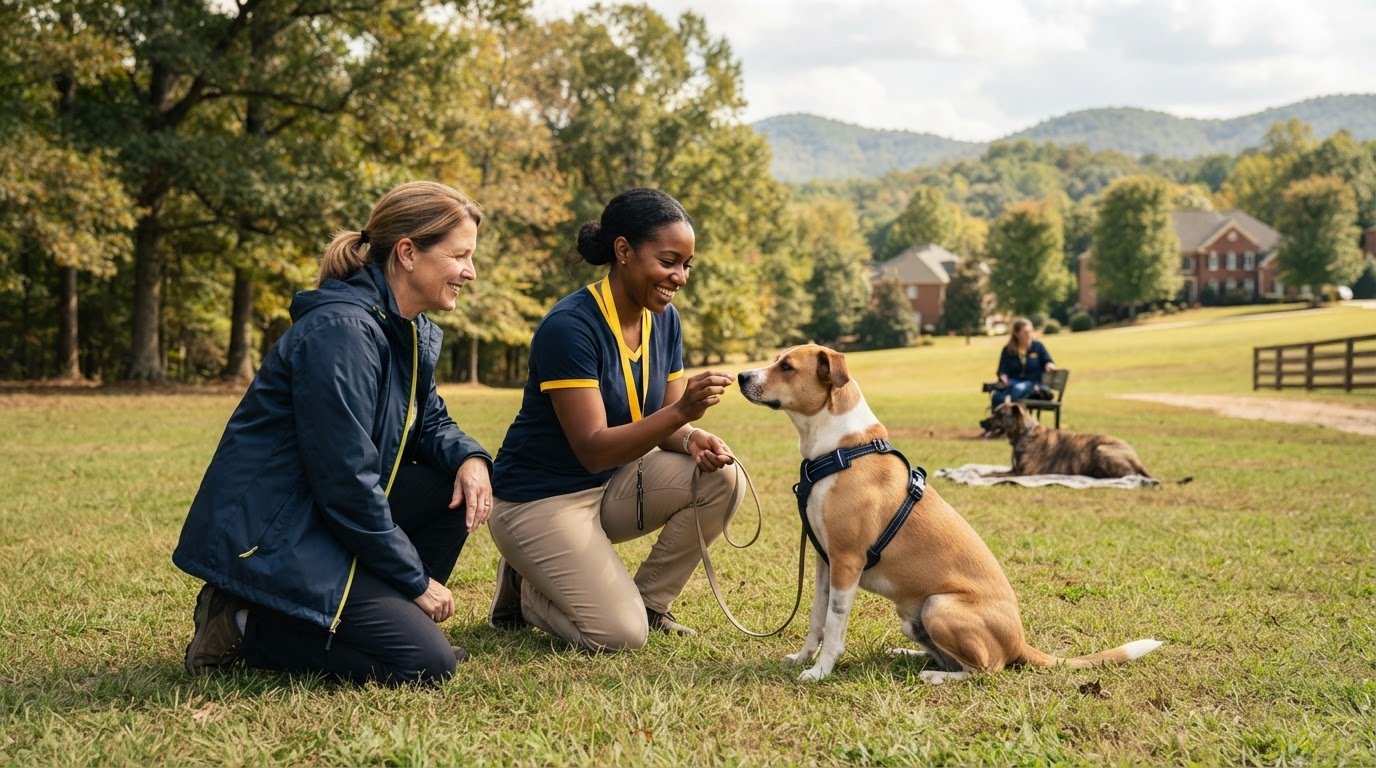
Home is where small misunderstandings can become daily frustrations. Your dog may bark when someone approaches the door, pull toward a window, or struggle to settle while the family is busy. Personalized In-Home Dog Training lets you work on communication in the setting where these moments happen. The trainer can observe the routine, help you understand what your dog responds to, and guide you through relevant skills.
Customized training adapts instruction to your dog’s behavior and household goals, making practice relevant to the life you share. A plan may combine positive reinforcement, clear communication, structure, and appropriate tools. The approach is tailored to the dog and the training priorities, rather than applied as a one-size-fits-all formula.
What personalized In-Home Dog Training can address
One-to-one coaching can support obedience, household routines, and clearer communication between you and your dog. You might practice a calm greeting at the door, teach a place cue while you prepare dinner, or build focus before clipping on the leash. These are examples, not assumptions about what every rescue dog needs. The starting point is what’s happening in your home and what you want to change.
Coaching also gives you a chance to practice with guidance in familiar surroundings. You learn how to give a cue, notice your dog’s response, and reinforce the behavior you’re looking for. Between sessions, short, consistent practice helps make skills part of everyday life. Choose a manageable moment, such as asking for a pause before opening the door, and use the same clear cue each time.
• Keep practice focused on one useful skill at a time.
• Use the same cue and household expectations consistently.
• Notice which situations make the skill easier or harder for your dog.
When behavior concerns need individualized support
Some concerns call for more than general obedience practice. Behavior Modification provides individualized support for issues such as anxiety, reactivity, destructive behavior, and aggression. A trainer can help you examine the situations around a behavior and identify practical training priorities. The ASPCA’s overview of understanding common dog behavior issues also explains why behavior has context and deserves thoughtful attention.
Progress takes practice and realistic expectations. Training can help address challenging behaviors, but it isn’t an instant fix or a promise that every behavior will disappear. Follow the agreed guidance, keep routines as consistent as you can, and share observations so coaching can respond to your dog. For Dallas-area owners considering a home-based approach, personalized In-Home Dog Training can help turn daily interactions into opportunities to build clearer communication.
Which Training Approach Fits a Rescue Dog’s Needs in Dallas, GA?
There isn’t one format that suits every rescue dog. A dog who needs everyday obedience practice may have different priorities from one whose anxiety or reactivity affects daily life. The useful question isn’t “Which option is best for all rescue dogs?” It’s “What kind of support fits this dog’s behavior and our goals?” The recommendation should follow an evaluation, not the dog’s adoption status alone.
In-home coaching or structured Group Classes?
Each option serves a distinct purpose. Personalized In-Home Dog Training offers one-to-one coaching around goals that matter to your household. Group Classes provide trainer-led, structured obedience practice. Behavior Modification focuses on individualized support for behavior concerns that need targeted attention. These are different routes to training, not a ranking from best to worst.
In-Home Dog Training
Work on personalized goals in your home and everyday environments, with coaching shaped around your routines and priorities.
Group Classes
Practice obedience skills in a structured, trainer-led class setting. This is not individualized behavior rehabilitation.
Behavior Modification
Receive individualized support for challenges such as anxiety, reactivity, or aggression.
A dog who knows basic cues but needs practice following them around other people may benefit from structured class work. If a behavior makes daily routines difficult, individualized Behavior Modification may be a more relevant direction. If household communication is the priority, in-home coaching can address goals in that context. These examples can help you describe your needs, but they don’t determine the plan. Your dog’s behavior and your goals both matter.
How the training method supports a working partnership
The format is only part of the picture. Training should also be customized to the individual dog, combining positive reinforcement, clear communication, structure, and appropriate tools. This balanced approach gives the trainer and owner a shared framework while allowing instruction to respond to the dog’s behavior and the skills the household wants to build. For a broader perspective on animal welfare and rescue dogs, consider how thoughtful, individual care supports a dog’s well-being.
Your participation makes the work practical beyond a coaching session. Follow the guidance, practice agreed-upon skills consistently, and share what feels easy or challenging. A cue that works in a quiet room may take more practice in a distracting setting. Small, repeatable steps help build clearer communication without expecting instant change or a guaranteed outcome. For additional context on home-based coaching, the Professional In-Home Dog Training: A Comprehensive Guide for Owners can complement the evaluation-led process used to determine which training direction fits.
Your First Steps With a Rescue Dog Trainer Near Dallas, Georgia
Starting training doesn’t require you to have all the answers. Describe what you’re seeing and what you hope will change. An evaluation connects those everyday observations to a practical recommendation for you and your dog. The focus is on understanding your dog’s needs now, not asking you to explain an unknown past.
Describe your main concern.
Choose a specific example, such as difficulty settling when visitors arrive or pulling during walks.
Share relevant routines.
Explain when the behavior occurs, who is present, and what usually happens before and after.
Complete an evaluation.
This gives the trainer a chance to assess your dog’s needs and learn about your household goals.
Review recommendations.
Discuss the proposed direction and what practice may involve for you and your dog.
Pricing depends on your dog’s needs, so an evaluation is required for an accurate recommendation. This process keeps the suggested approach and pricing specific to your situation.
What to share during the evaluation
Useful information is observable and specific. Describe what your dog does, where it happens, how often you notice it, and what the household routine looks like around that moment. Share the skills you’d like to build, too, such as calmer greetings or more reliable leash manners. You don’t need to diagnose your dog or guess whether a behavior comes from its adoption history. Concrete details help the trainer shape an individualized recommendation around your dog and your goals.
If you’re unsure what matters, keep a few notes as situations arise. For example, record that your dog barks when someone knocks rather than concluding that it’s afraid of visitors. Include what you tried and how your dog responded. These observations give the evaluation useful context without treating one incident as the whole story.
How local training can carry into everyday life
Training is most useful when skills connect to the places you and your dog actually go. Home practice can support household routines, while neighborhood walks can provide opportunities to work on leash skills. Depending on the goals, practice may also extend to parks or pet-friendly stores. The setting should fit your dog’s needs and the skill being developed, rather than adding distractions before your dog is ready.
Alan’s K9 Academy serves Dallas and surrounding North Metro Atlanta communities. An evaluation helps determine the recommended plan, including how training can address relevant home and real-world situations. If you’re ready to turn your observations into a clear starting point, connect with Alan’s K9 Academy about an evaluation.
How Alan’s K9 Academy Helps Rescue-Dog Owners in Dallas and North Metro Atlanta
Welcoming a rescue dog can be rewarding and uncertain at the same time. You might celebrate small signs of trust while still wondering how to handle a behavior that disrupts daily life. Alan’s K9 Academy serves Dallas and surrounding North Metro Atlanta communities with personalized dog training shaped around each dog’s observed needs and the owner’s goals. The aim is to give you a practical path forward, not to make assumptions about your dog’s history or promise an overnight change.
Master Trainer Alan Carr brings over 35 years of professional dog-training experience. Alan’s K9 Academy was a Best of Georgia winner for 2024 and 2025. The process starts by understanding what’s happening, identifying useful priorities, and recommending a direction suited to the dog and household. For owners looking for a dog trainer for rescue dogs Dallas GA, an evaluation is a meaningful first step toward understanding which approach may fit.
A personalized program shaped by evaluation
An evaluation connects your goals with your dog’s observed behavior. Explain what’s challenging, what you’ve already tried, and what you want everyday life to look like. The recommended training plan is then tailored to the situation. Acceptance into a program and the recommended plan are determined through an evaluation, so dogs aren’t automatically placed into the same program or given the same approach.
Depending on the needs identified, In-Home Dog Training can focus on communication and skills within the home. Behavior Modification offers individualized support for concerns such as anxiety, reactivity, or aggression. The right recommendation depends on the evaluation, and progress calls for practice and realistic expectations. Training is not an instant fix, but consistent work can help you build clearer communication and useful skills with your dog.
The Life-of-Dog Support Guarantee includes continued assistance with program commands and issues, subject to its terms. It provides support related to the program, not a promise that every behavior will disappear or that progress will happen on a set timeline.
Take the next step with a local trainer
Before scheduling, jot down the main concern and a few examples of when it occurs. Think about what you’d like to improve, whether that’s calmer routines, more reliable obedience, or help with a specific behavior. You don’t need to arrive with a diagnosis or a complete account of your dog’s past. Your observations and goals give the evaluation a useful starting point.
Alan’s K9 Academy works with owners and dogs across Dallas and surrounding North Metro Atlanta communities. The evaluation determines whether a program is appropriate and which training plan is recommended for your dog. If you’re ready to discuss your concerns and begin, schedule an evaluation with Alan’s K9 Academy.
Build Your Next Chapter Together
Your rescue dog doesn’t need a perfect past or a flawless first week for you to move forward. Stay curious about what your dog is communicating and choose one meaningful skill to work on together. A calmer greeting, a more connected walk, or an easier household routine can become a shared goal, built through patience and practice.
Working with a dog trainer for rescue dogs Dallas GA can help turn uncertainty into a thoughtful path that respects your dog’s needs and your family’s everyday life. Progress may take time, but each clear cue and consistent response can help strengthen the partnership you’re building.
Take the next step when you’re ready. Schedule an evaluation with Alan’s K9 Academy and start shaping a practical plan for you and your dog. A supportive beginning can lead to a more confident future, one day and one skill at a time.
Frequently Asked Questions
Can an older rescue dog still learn new behaviors?
Yes, older rescue dogs can learn new behaviors; age alone doesn’t rule out learning. Start with one practical goal, such as waiting calmly before going through a doorway, and build practice into an ordinary routine. Use consistent cues so your dog can understand what you’re asking. An evaluation can help identify a suitable starting point based on your dog’s individual behavior and needs.
How long does it take a rescue dog to adjust to a new home?
Adjustment has no fixed deadline. The often-used 3-3-3 rule is a rough guide: about 3 days to decompress, 3 weeks to learn household routines, and 3 months to begin feeling at home. It isn’t a promise or a test. Keep early days calm, maintain predictable meal and rest schedules, and introduce new people or places gradually. Watch your dog’s cues rather than comparing progress to a calendar.
Is an in-home trainer a good fit for a rescue dog?
It can be, especially if you want coaching around situations that happen at home. A trainer can observe how your dog responds to everyday routines and guide you as you practice relevant skills. If you’re searching for a dog trainer for rescue dogs Dallas GA, consider whether your goals involve household communication, obedience, or a behavior concern. An evaluation helps determine whether in-home training suits your dog’s needs.
What should I tell a trainer about my rescue dog?
Share specific observations rather than guesses about your dog’s past. Describe what your dog does, where it happens, what usually occurs beforehand, and how you respond. Mention your routines, any cues your dog knows, and the changes you’d like to make. For example, explain that your dog paces when left in another room instead of trying to diagnose why. These details help the trainer understand your goals and recommend an individualized direction.
Can rescue dogs with reactivity or anxiety get professional training help?
Yes. Behavior Modification provides individualized training support for concerns such as anxiety, reactivity, and aggression. Share the situations that trigger a response, how your dog behaves, and what helps the dog settle afterward. That information helps guide an appropriate evaluation and training recommendation. Progress depends on the dog and the work involved, so professional training can help address these concerns without promising instant change or that every behavior will disappear.
How much does rescue-dog training in Dallas, GA cost?
Training pricing depends on your dog’s needs, so one price won’t accurately apply to every rescue dog. An evaluation is required to make an accurate recommendation and discuss a plan suited to your situation. Be ready to explain your main goals and the behaviors you’d like help with. That context helps connect the recommendation and pricing to the training needs identified during the evaluation.
Does Alan’s K9 Academy offer training for every rescue dog?
Dogs of many breeds, ages, and temperaments may be considered, but no dog is automatically accepted into a program. Alan’s K9 Academy serves Cartersville, Canton, Woodstock, Marietta, Rome, Acworth, Kennesaw, Sandy Springs, Roswell, Alpharetta, Powder Springs, Dallas, Hiram, Jasper, Cumming, Holly Springs, Ball Ground, and Milton.