



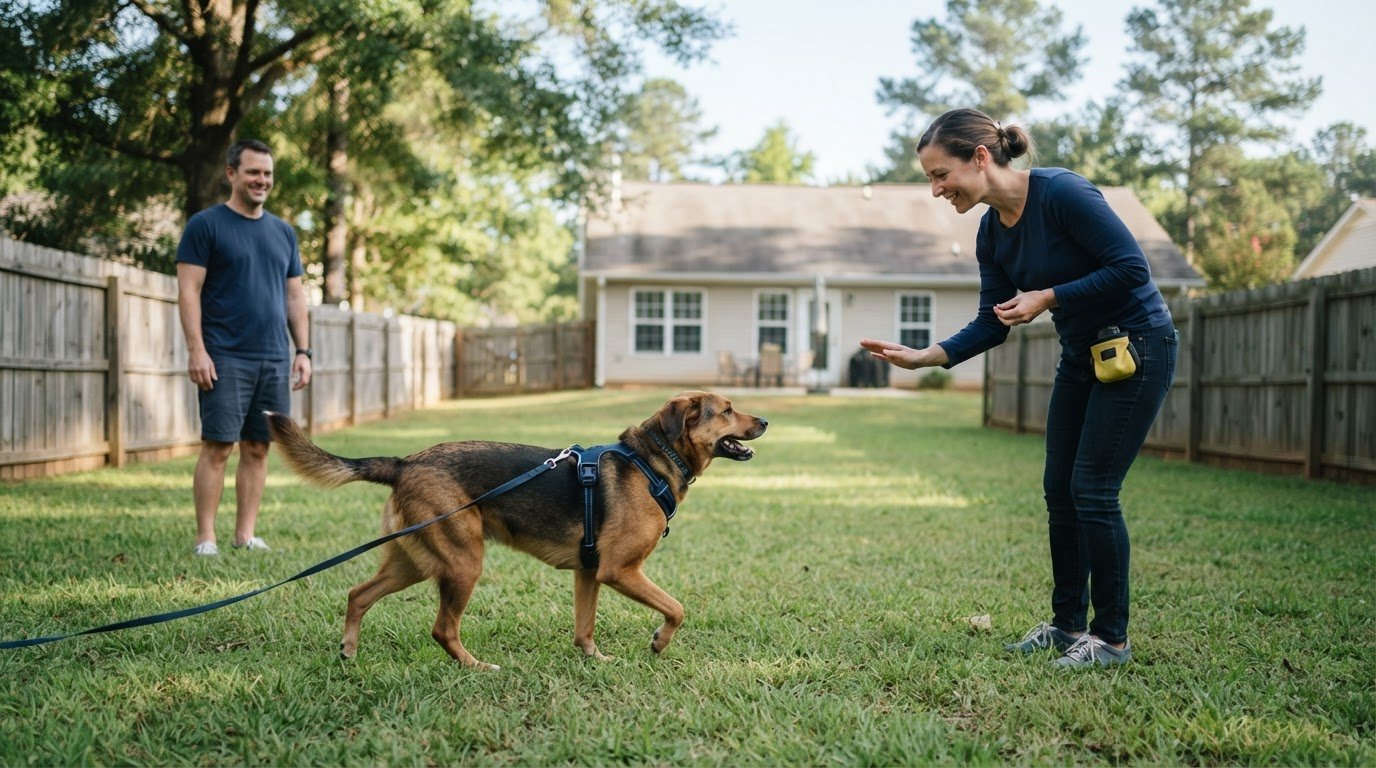
Dog Listens to Husband but Not Me? Better Training Tips
Your dog isn’t choosing a favorite; they’re responding to what they’ve learned to expect from each person. If you’re thinking, “My dog won’t listen to me but listens to my husband,” the difference may reflect each person’s training history and how consistently cues are practiced and rewarded. Dogs t...

Your dog isn’t choosing a favorite; they’re responding to what they’ve learned to expect from each person. If you’re thinking, “My dog won’t listen to me but listens to my husband,” the difference may reflect each person’s training history and how consistently cues are practiced and rewarded. Dogs tend to respond more reliably to the person who regularly reinforces a behavior, so both of you can improve the pattern by taking part in training.
It can be frustrating when your dog responds to your husband but ignores you, especially when you’re both trying to help. Consistent cues, rewards your dog values, and patient practice can build a more reliable response. Shared household routines and everyday reinforcement help your dog learn to listen to both of you, though lasting behavior change takes time.
Key Takeaways
• Have both household members practice the same cues so your dog learns to respond to each person.
• Notice which rewards and interactions help your dog stay engaged, then reinforce the behaviors you want to see.
• Keep expectations realistic: reliable behavior develops through steady practice and patience, not overnight.
• Learn how consistent household training can help your dog respond more reliably in everyday situations.
Building obedience and leadership through training
Practicing together helps your dog learn that the same cues matter with both people. Calm, consistent training builds cooperation without keeping your dog in work mode all day.
Setting the Tone for Training
Set a calm, focused tone before a walk or practice session. Before clipping on the leash, get your dog’s attention and choose a simple cue, such as “heel.”
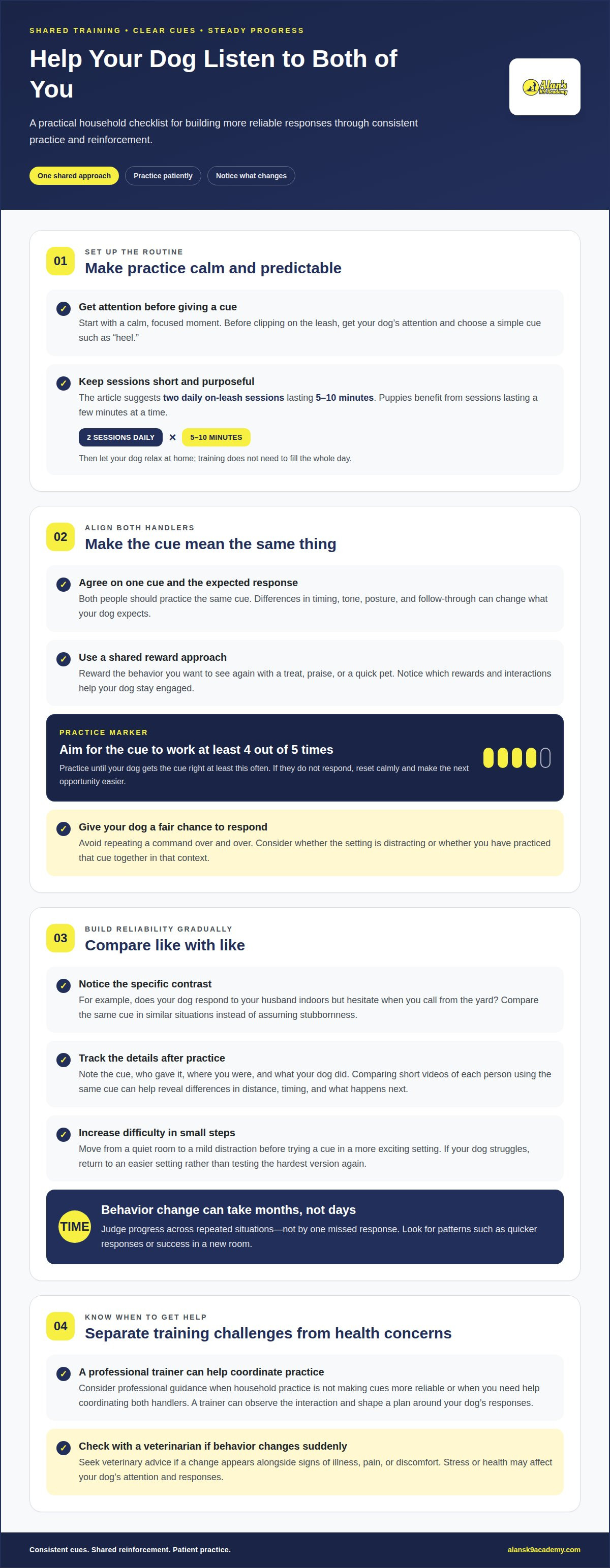
Keep practice short and purposeful: two daily on-leash sessions of 5-10 minutes give you a clear routine. Puppies benefit from sessions lasting a few minutes at a time. Then let your dog relax at home; training doesn’t need to fill the whole day.
Building Trust Through Positive Reinforcement
Positive reinforcement means rewarding a behavior you want to see again with a treat, praise, or a quick pet. It helps your dog understand which response works and gives both household members a constructive way to build cooperation.
Use the same cue and reward approach, then practice until your dog gets the cue right at least 4 out of 5 times. If your dog doesn’t respond, avoid repeating the command over and over. Reset calmly and make the next opportunity easier.
Getting a Dog’s Attention
Get your dog’s attention before giving a cue. Call your dog over, ask for “heel,” and tap your leg before asking for a sit. A kibble reward can help maintain engagement.
On a walk, use a familiar cue such as “leave” or “heel” to redirect an excited dog. Avoid starting by leaning down and speaking in a high-pitched voice. A clear, steady approach helps your dog recognize that practice is beginning.
Seeking Professional Guidance
Bring in a professional trainer when household practice isn’t making cues more reliable or you need help coordinating both handlers. A trainer can observe the interaction and shape a plan around your dog’s responses.
For a multi-dog home, Ed Frawley advises keeping dogs apart until the young dog can be called away during hard play. Consult a veterinarian if a behavior change appears alongside signs of illness, pain, or discomfort. This helps distinguish a training challenge from a possible health concern.
Differences in rewards and reinforcement between household members
Dogs learn from their experiences with each person, so the same cue can prompt different responses. Fear or stress may affect a dog’s attention, and pain or illness can also change behavior. If the change is sudden or your dog seems uncomfortable, seek veterinary advice.
Different Responses to Household Members
A dog’s learning history with each household member can explain why responses differ. If one person often practices “come” in the kitchen and rewards the dog, while another uses the cue mostly around distractions, the dog may respond more readily to the first person. Differences in timing, tone, posture, and follow-through can also shape what a cue predicts.
Look for a specific contrast rather than assuming your dog is being stubborn. For example, note whether your dog responds to your husband indoors but hesitates when you call from the yard. Comparing short videos of each person giving the same cue can reveal differences in distance, timing, and what happens after the dog responds.
Inconsistent Training and Ignored Commands
Inconsistent practice can make a cue less clear for one handler. If only your husband trains for a few weeks, your dog may respond more reliably to him because he has practiced and reinforced the behavior more often. That reflects the dog’s learning history, not a deliberate choice to ignore you.
Agree on one cue, the expected response, and a shared reward approach. Give your dog a fair chance to respond before changing or repeating the cue. If your dog doesn’t respond, consider whether the setting is distracting or whether you’ve practiced the behavior together in that context. Comparing the same cue in similar situations makes differences between handlers easier to spot.
If coordinating practice remains difficult, in-home dog training can address how your household interacts with your dog in familiar settings.
Allowing time for behavior change
Behavior change can take months rather than days, so a few missed responses don’t mean training has failed. Your dog may learn “come” with you indoors, then struggle with the same cue in the yard, where there are different distractions. Judge progress by whether your dog responds more consistently across repeated situations, not by one difficult moment.
After practice, note the cue, who gave it, where you were, and what your dog did. For example, record whether “sit” works in the kitchen with you but not near the front door. These notes can show which setting or handler needs more practice and help distinguish a genuine change from an unusually distracting moment.
Build difficulty gradually. If your dog responds to “stay” in a quiet room, practice near a mild distraction before trying it during an exciting walk. Keep the cue and expected response consistent, and reward the behavior you want repeated. If your dog struggles, return to an easier setting rather than testing the hardest version again. This makes progress easier to assess.
Look for patterns over time, such as quicker responses to you or success in a new room. A pause in progress can be a reason to adjust the setting, reward, or cue timing, rather than repeat commands more forcefully. If behavior changes suddenly or your dog seems uncomfortable, consider whether stress or health could be affecting responses. Patience works best alongside careful observation and steady practice.
Does inconsistent training make a dog ignore one owner?
Yes. If one person practices and rewards a cue regularly while the other rarely uses it, the dog may respond much better to the person who trains consistently. A few weeks of one-sided practice can build a clear learning history with that handler, while the cue from the other person has less predictable meaning. That isn’t deliberate defiance; it’s a difference in what the dog has learned to expect.
Imagine one person says “come” before dinner and rewards the dog for arriving. The other calls the dog only when play ends, then sometimes gives up when the dog keeps playing. Those moments teach the dog different things about the cue. Align the word, expected response, and follow-through so “come” means the same thing with both people.
Agree on an approach before your next practice. Choose one cue for each behavior, decide what response earns a reward, and take turns practicing in familiar settings. For example, both people can ask for “sit” in the same room and reward the same response. If your dog misses the cue, pause and make the situation easier rather than repeating it several times or changing the wording.
Keep a simple record of who practiced each cue and what happened. A note such as “Tuesday, kitchen, ‘down,’ responded after one cue” gives both handlers something concrete to compare. If your dog responds to one person but not the other, practice with the less familiar handler in an easier setting first. Consistency doesn’t mean identical delivery; it means predictable cues and consequences.
For hands-on support aligning practice across your household, get help with shared dog training.
Alan's K9 Academy
Alan's K9 Academy can help when your dog responds to one household member more reliably than another, or shared practice hasn’t resolved the gap. In-home dog training lets the trainer work with your family and dog in the setting where different responses occur. Behavior modification can address behavior patterns that make everyday cues difficult to manage.
The focus is on understanding what happens before and after a cue, then helping household members build a consistent approach. This can be useful when you’re unsure why your dog listens to your husband but not you, or need practical guidance for training together. Contact Alan's K9 Academy to discuss support for your dog and household.
Build a More Reliable Partnership
Take the next step by turning training into a shared effort, with both household members using clear, consistent cues. If your dog won’t listen to you but listens to your husband, that difference is a useful starting point for understanding what your dog has learned and where support could help.
Alan's K9 Academy offers In-Home Dog Training and Behavior Modification to support household training and behavior needs, as well as Therapy & Service Dog Training. The right guidance can help you and your dog work toward clearer communication in everyday life.
Contact Alan's K9 Academy to discuss a thoughtful next step for your dog. With patience and a plan that fits your household, you can keep building a stronger connection together.
Frequently Asked Questions
How can I use this to better train my pet?
Choose an everyday moment to practice together, such as waiting calmly before a door opens. One person gives the cue while the other helps keep things quiet; switch roles another time. Reward the behavior you want, such as waiting instead of rushing through. This turns a routine moment into useful practice and helps both people share responsibility without adding a complicated training session.
Why Does My Pet Listen to My Partner and Not Me?
Your dog may have learned that your partner’s cues predict a familiar outcome, such as getting a toy or going outside. Your cues may come in more exciting or less predictable situations. Notice which requests your dog follows with each person. If your partner’s “come” works before dinner but yours doesn’t during play, the situation may matter as much as the speaker.
Why does my dog listen to my husband and not me?
It doesn’t mean your dog loves your husband more or respects you less. Dogs respond to what they’ve learned in particular situations, and everyday routines can create different expectations. Your husband may usually call your dog when the leash comes out, while you call during a busy moment. Consider what happens immediately before and after each cue to identify what your dog may be anticipating.
Why is this?
The difference often reflects what your dog has learned to associate with each person’s cues, not a deliberate decision to ignore someone. For example, your dog may approach your partner when they pick up a favorite ball but not when you call from another room. That contrast can reveal which situations make responding easier or harder, giving you a useful starting point for tailored practice.
Why does my dog listen to my husband but not me?
If your dog won't listen to you but listens to your husband, look beyond the cue itself. Your dog may respond to your husband’s hand signal, position, or routine, even when you both say the same word. Try saying the cue without those extra prompts, then notice what changes. This can show whether your dog understands the spoken cue or follows another familiar signal.
How do dogs choose which person to obey?
Dogs don’t rank household members the way people do. They learn which cues and situations predict outcomes they value, such as a walk, play, or attention. A dog might follow one person’s signal near the leash but respond to another person during a familiar game. Look at the context of each response, not just who gave the command, to understand the pattern.